How to close a company in Thailand: dissolution and liquidation
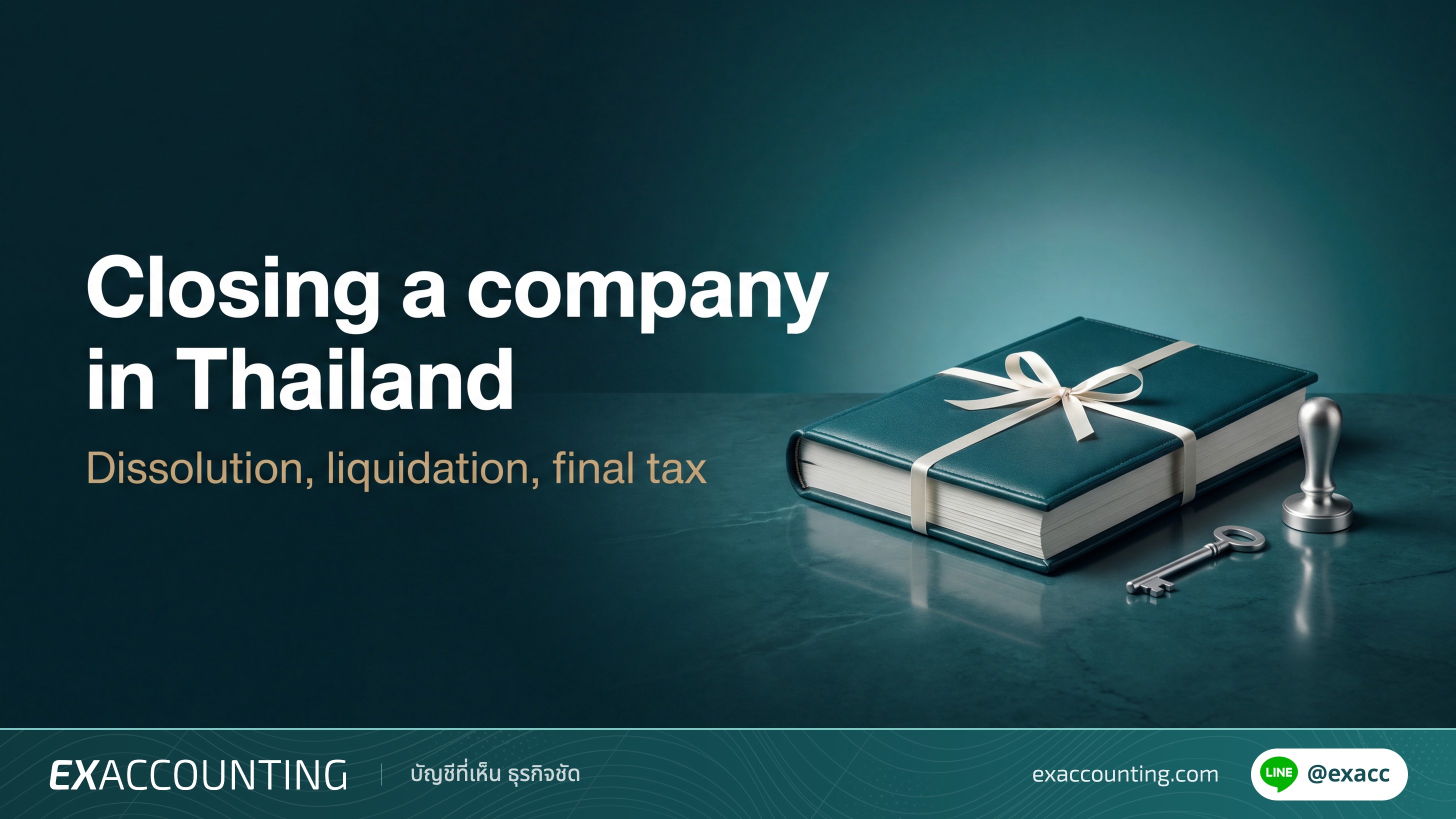
Closing a Thai company takes two steps: DBD dissolution, then liquidation. See the 14-, 15- and 150-day deadlines and the extra steps for VAT-registered firms.
Closing a Thai limited company takes two steps: register the dissolution with the Department of Business Development (DBD), then finish the liquidation and register its completion. Along the way you must notify the Revenue Department within 15 days of the dissolution being registered and file a final PND 50 within 150 days. The company does not disappear until the liquidation is registered as complete, so its filing and tax duties continue until then.
Can you just stop trading without dissolving?
You can, but a company with no income keeps the same duties. It still has to close its books and file financial statements with the DBD every year, file PND 50, and, if it is VAT-registered, file PP 30 every month even with no sales. If you are sure you will not restart, dissolving properly is usually cheaper than keeping an empty company alive for years.
On the other hand, if you plan to restart the same business soon, there is no rush to dissolve: dissolving and incorporating again both take steps and money.
Step 1: Register the dissolution
- Hold a shareholders' meeting and pass a special resolution to dissolve, with at least three quarters of the votes of the shares present. Send the meeting notice at least 14 days before the meeting, or as the articles require.
- Appoint the liquidator. If the articles say nothing, all directors become liquidators by law. To appoint only some directors or an outsider, the shareholders' meeting must resolve it.
- File the dissolution on forms Lor Chor 1 and Lor Chor 2 at the DBD office or provincial commerce office where the head office is, or through the DBD e-Registration system.
- Publish a notice in a local newspaper at least once and send a notice by registered mail to every creditor (if any).
The liquidator must complete items 3 and 4 within 14 days of the dissolution.
Step 2: Liquidate
- Prepare financial statements as at the dissolution date and have a licensed auditor audit and certify them.
- Settle assets and liabilities: sell assets, collect from debtors, pay debts and pay the costs of the liquidation.
- Return what is left to shareholders in proportion to their shareholdings, or as the articles provide.
- If the liquidation is not finished within 3 months of the dissolution, file a liquidation report (Lor Chor 3) every 3 months. If it runs past a year, call a general meeting at the end of every year to report progress.
- Hold a shareholders' meeting to approve the liquidation report, with notice at least 7 days before the meeting, or as the articles require.
- Register the completion of the liquidation within 14 days of the meeting's approval.
The completion filing includes Lor Chor 1, 3, 5 and 6, the financial statements as at dissolution and the Revenue Department's account audit certification form. Your tax affairs therefore have to be in order before the company can actually be closed.
This is the slowest part, because every account must be reconciled before the auditor will certify it. If past bookkeeping is behind or documents are missing, getting an accounting firm to review the closing and tax work before the dissolution resolution shows you early what still needs collecting.
What to file with the Revenue Department
- Notice of dissolution: the liquidator and the manager jointly notify the assessment officer within 15 days of the registrar accepting the dissolution.
- PND 50 for the year of dissolution: the date the dissolution is registered counts as the last day of the accounting period. File within 150 days of that date at the area revenue office for the head office. The liquidator and the manager are jointly responsible.
- Extension: if PND 50 cannot be filed in time, apply to the Director-General within 30 days of the dissolution being registered.
- Final withholding tax: if salaries or service fees are still paid during the liquidation, PND 1, PND 3 and PND 53 are still due as usual.
Extra steps for VAT-registered companies
- File PP 09 to notify the cessation of business and return the PP 20 registration certificate within 15 days of ceasing business.
- Inventory and business assets still held on the cessation date count as a sale. VAT is due on their market value on that date. No tax invoice is issued for this.
- Keep filing PP 30 until the company is struck off the VAT register, even in months with no sales. From the date you notify cessation, you may no longer issue tax invoices.
The Revenue Department has ruled that transferring all goods and assets to another VAT-registered entity is not a sale, but this depends on each case's facts, so consult your area revenue office first.
If you have employees
You must still pay wages and every amount employees are entitled to under labour law, remit the final contributions on SSO 1-10, and notify the Social Security Office that each employee has left. Check the deadline and form with your local Social Security Office.
Common misunderstandings
- "Once dissolution is registered, the company is gone": the company continues to exist for the liquidation and only ends when the completion of liquidation is registered.
- "No income means no financial statements": a company that has not been dissolved must file statements and PND 50 every year, income or not.
- "Repay shareholders first, then the debts": debts and liquidation costs come first; shareholders receive only what is left.
- "After closing, the records can be thrown away": the books and documents are listed and submitted on Lor Chor 6, and claims against the company, its directors or liquidators can still be brought for 2 years after the liquidation is completed.
FAQ
How long does closing a company take?
It depends on how quickly assets, debts and taxes can be settled. The law sets deadlines for each step, such as 14 days after the resolution and a report every 3 months while unfinished, but no overall limit.
What are the registration fees?
The DBD's step guides list a fee of 500 baht at both the dissolution step and the completion-of-liquidation step. This excludes the newspaper notice, the auditor and bookkeeping. Check current rates on the DBD hotline 1570.
Do partnerships follow the same steps?
The principle is similar, but partnerships have their own forms and conditions; see the DBD's separate partnership guide.
Who signs the dissolution application?
The liquidator. If all directors are liquidators, they sign according to the directors' signing authority registered before dissolution. If several liquidators are appointed with no stated authority, all of them must sign together.
References
Checked 15 November 2026
- DBD: Registering the dissolution of a limited company, step 1 (Thai)
- DBD: Liquidation and registering its completion for a limited company (Thai)
- Revenue Department: Ceasing business, corporate income tax (Thai)
- Revenue Department: Ruling 0706/8299 on ceasing business and VAT (Thai)
- Revenue Department: Form PP 09 (Thai)
Want our accountants to look at this for you?
Add us on LINE and tell us about your business. Our assistant will ask a few basics before passing you to an accountant.