The Thai income statement: how to tell if you really made a profit
The income statement shows revenue, expenses and profit for the year. See the DBD line items, a multi-step example and the margins owners should track.
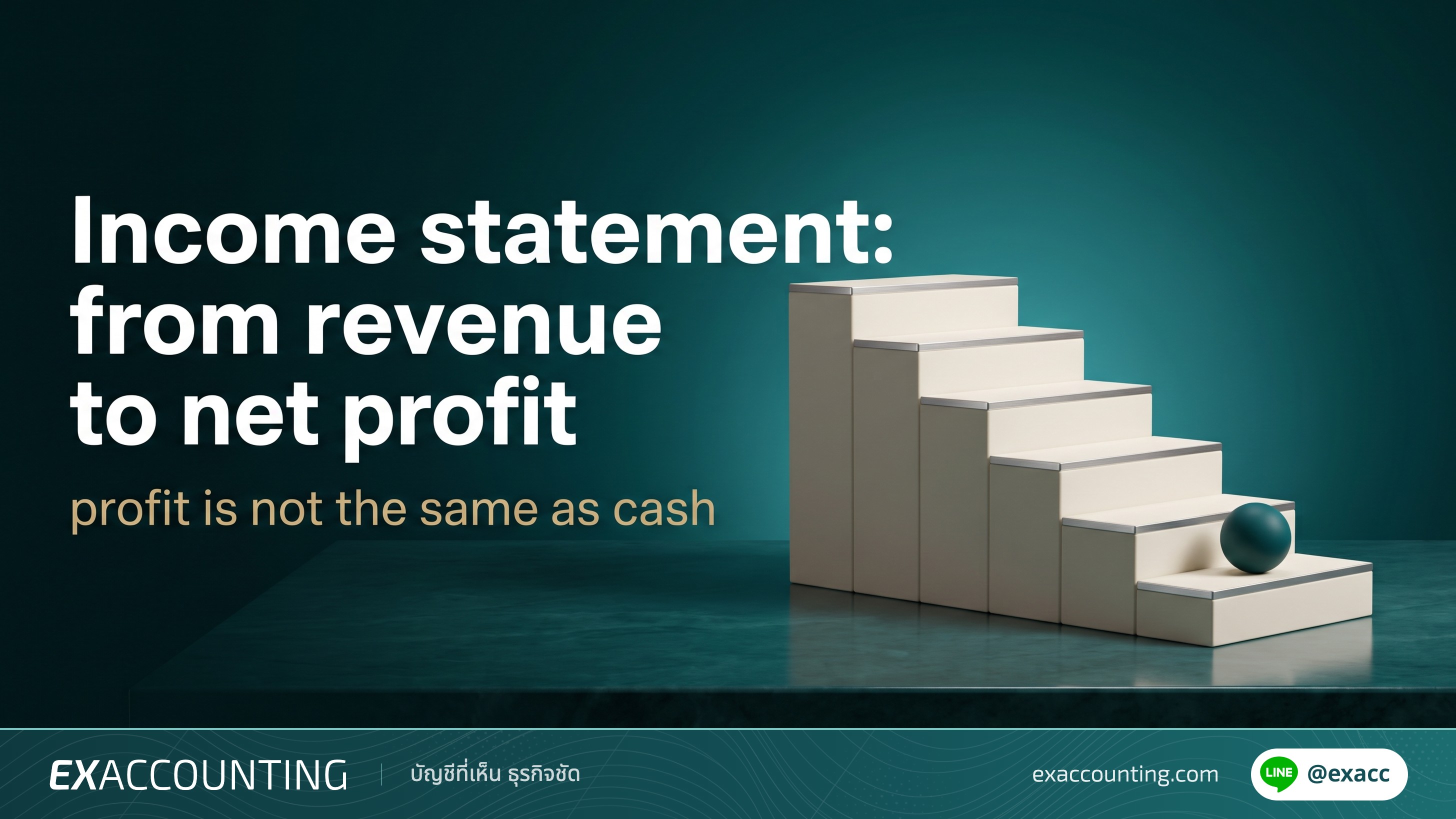
The income statement summarises a business's performance over a period, usually one accounting year. It starts with revenue, deducts costs and expenses group by group, and ends with net profit or loss. It is one of the required parts of the financial statements of Thai companies and registered partnerships. Entities using TFRS for NPAEs may present either an income statement or a statement of comprehensive income; public limited companies present a statement of comprehensive income.
How is it different from the statement of financial position?
- Period: the income statement covers a whole period, such as 1 January to 31 December; the statement of financial position is a snapshot of one day.
- Question answered: the income statement answers "how much did we make or lose this year"; the statement of financial position answers "what do we have and what do we owe now".
- Account groups: the income statement uses revenue and expenses; the statement of financial position uses assets, liabilities and owners' equity.
- At year end: revenue and expenses are closed to retained earnings and start again from zero, while balance sheet amounts carry forward.
The structure set by the DBD
The Department of Business Development (DBD) notification on minimum line items in financial statements B.E. 2566 (2023) allows expenses to be classified in two ways:
- By function: cost of sales or cost of services, selling expenses, administrative expenses and other expenses. This can be single-step, deducting all expenses from total revenue at once, or multi-step, showing gross profit first.
- By nature: by type of expense, such as raw materials and consumables used, changes in finished goods and work in progress, employee benefit expenses, depreciation and amortisation, and other expenses.
Both end with the same lines: profit before finance costs and income tax, finance costs, profit before income tax, income tax, and net profit. Most trading businesses prefer the multi-step format because gross profit is easy to see.
A multi-step example
A kitchenware shop, with illustrative figures for the year:
| Item | THB |
|---|---|
| Sales revenue | 3,000,000 |
| Less cost of sales | (1,950,000) |
| Gross profit | 1,050,000 |
| Other income | 15,000 |
| Less selling expenses | (180,000) |
| Less administrative expenses | (560,000) |
| Profit before finance costs and income tax | 325,000 |
| Less finance costs (interest) | (25,000) |
| Profit before income tax | 300,000 |
| Less income tax | (xx,xxx) |
| Net profit | xxx,xxx |
Income tax is left blank because it is calculated on taxable profit, not directly on accounting profit, and the rate depends on the size of the business. See corporate income tax and PND 50.
Figures owners should check every year
- Gross margin: gross profit divided by sales. In the example, 1,050,000 ÷ 3,000,000 = 35%, meaning every THB 100 of sales leaves THB 35 to cover other expenses. If this falls every year, costs are rising faster than prices.
- Net margin: net profit divided by total revenue, showing what is finally left from every THB 100 of sales.
- Each expense group against revenue: see which grows faster than sales, for example admin costs up 20% while sales rise 5%.
- Other income, separately: profit from a one-off item, such as selling a company car, does not mean the core business improved.
Profit is not cash, and not taxable profit
The income statement uses the accrual basis. Revenue is recorded when goods or services are delivered, even if unpaid; expenses are recorded when incurred, even if unpaid; and depreciation is an expense with no cash leaving that year. The figures reflect real performance only once the accountant has recorded all year-end adjustments, which you can check in the adjusted trial balance.
Taxable profit differs again, because the Revenue Code does not allow certain expenses to be deducted for tax. The accountant adds them back before calculating tax. Mid-year, a company must estimate full-year profit to file PND 51, so an accurate half-year income statement keeps the estimate on track.
Can you do it yourself?
Reading the income statement and comparing it with last year is something every owner can and should do each quarter. Preparing it yourself is possible if you have a correct adjusted trial balance and group the accounts into the DBD lines. The usual weak points are year-end adjustments and separating non-deductible expenses. If you want our bookkeeping team to prepare the statements and summarise the figures for you every month, see the scope on our pricing page.
FAQ
What is the difference between an income statement and a statement of comprehensive income?
A statement of comprehensive income is an income statement followed by other comprehensive income, such as revaluation gains. Entities using TFRS for NPAEs may choose either; public limited companies use the statement of comprehensive income.
Can we prepare the income statement in Excel?
Yes, if you have a correct adjusted trial balance. When filing through DBD e-Filing, however, the figures are entered into the DBD's own form rather than submitted as your own file.
What happens after several years of losses?
Accumulated losses reduce owners' equity in the statement of financial position. If equity turns negative, banks and partners will notice. Tax losses can be carried forward against profits of later accounting periods for up to five years; see tax loss carryforward.
Why is quarterly profit so different from the year-end figure?
Usually because adjustments are recorded only at year end, such as depreciation, accrued expenses or the stock count. To make interim statements closer to reality, ask your accountant to record these monthly.
References
Checked 20 November 2026
Want our accountants to look at this for you?
Add us on LINE and tell us about your business. Our assistant will ask a few basics before passing you to an accountant.