Payslips in Thailand: what to include and how to keep them right
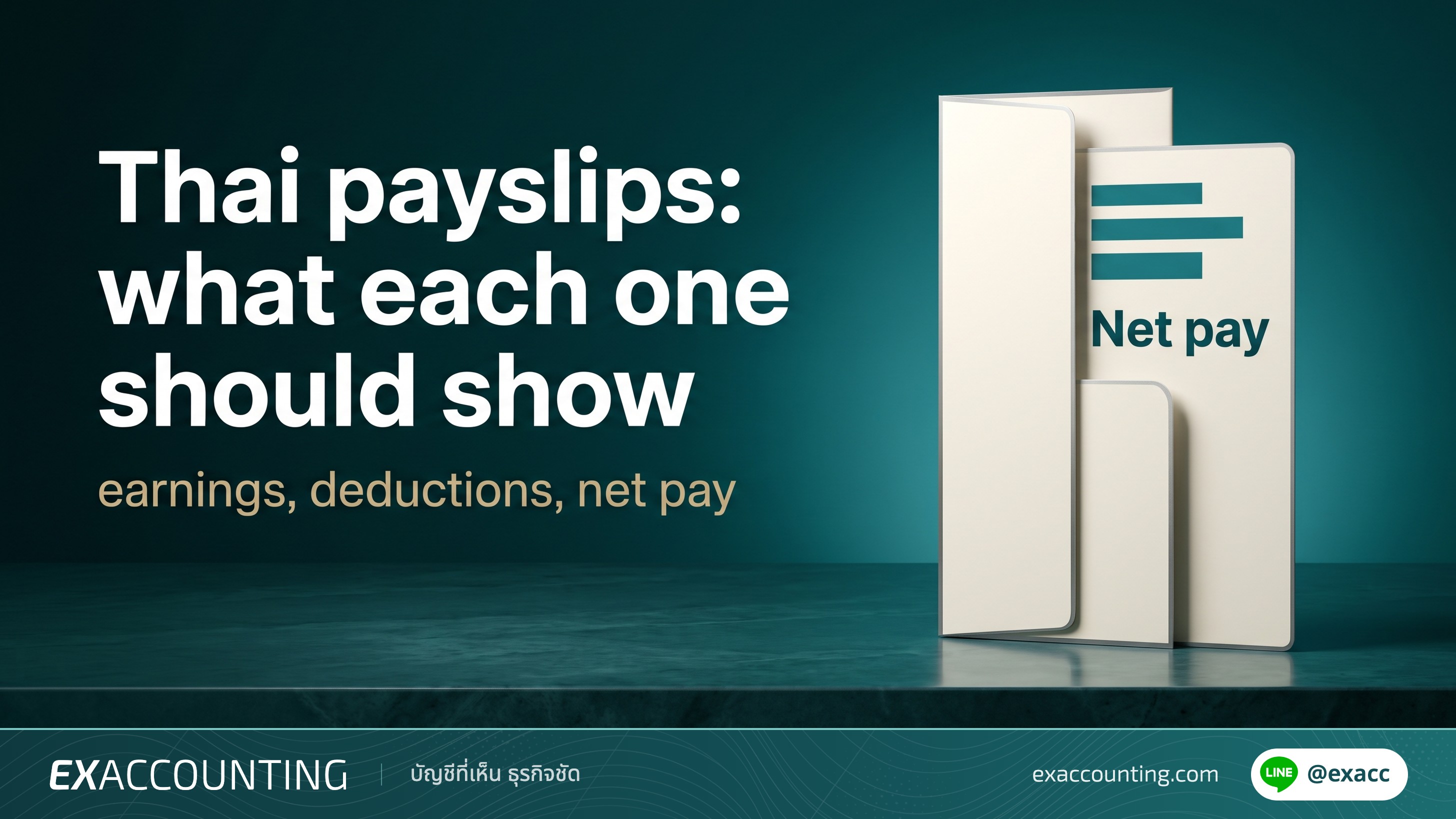
A Thai payslip should show earnings, deductions, social security, tax, net pay and year-to-date totals. What labour law requires and how to match PND 1.
A payslip should tell an employee five things: which period, what they earned, what was deducted, what they received net, and the year-to-date totals. Thai labour protection law does not prescribe a payslip form, but it does require employers to keep records of how wages were calculated and paid. A complete payslip answers employees' questions and is also the record you reconcile with PND 1 and social security every month.
What labour law requires
Under Thai labour protection law, records of wage, overtime and holiday pay calculations must show:
- days and hours worked
- output, where pay is by piece or result
- the amount paid
- the signature of the employee receiving the money
Employers with 10 or more employees must also have work rules in Thai that state when and where wages are paid.
The law does not use the word "payslip". A payslip is simply the most convenient way to give employees this information. The format, printed, PDF or email, is up to the employer, as long as the information is complete and copies are kept for later checks.
What a payslip should show
| Section | Items |
|---|---|
| Header | Employer name, employee name and ID, department or position, pay period, payment date |
| Earnings | Salary, or daily wage with number of days, overtime, holiday pay, attendance bonus, commission, bonus |
| Deductions | Social security, withholding tax, provident fund if any, other agreed deductions |
| Net pay | Total earnings less total deductions, and the account paid into |
| Year to date | Earnings, tax and social security since the start of the year |
Year-to-date totals are not required, but they are worth including. Employees can check them against their 50 Tawi at year end, and you can check whether the tax withheld so far is on track before filing PND 1 Kor.
Example payslip figures
An employee on 40,000 baht a month, paid in 2026, whose only allowances are the personal allowance and the social security actually deducted (875 x 12 = 10,500 baht):
| Item | Baht |
|---|---|
| Salary | 40,000.00 |
| Less social security (17,500 ceiling x 5%) | 875.00 |
| Less withholding tax | 704.17 |
| Net pay | 38,420.83 |
Social security uses the 17,500 baht ceiling, so 875 baht is deducted even though the salary is higher. The 704.17 baht tax comes from calculating the annual tax and dividing by 12; see how employers withhold tax from salaries.
What the payslip must agree with
The same figures appear in three other places:
- That month's PND 1: total tax on all payslips equals the tax remitted.
- That month's SSO 1-10: total employee contributions on all payslips equal the amount filed.
- The salary account in your books: total earnings on all payslips are the salary expense recorded.
If a payslip is corrected after payment but nothing else is, the figures stop matching from that month, and the gap usually surfaces only when the year is added up.
A monthly routine
- Update employee data: joiners and leavers, new salaries, bank accounts, allowances employees have declared.
- Collect the period's variables: days worked for daily staff, overtime hours, unpaid leave, commissions.
- Calculate, then check each slip: look especially at negative net pay or big changes from last month.
- Approve and lock the period: no later edits without a record of what changed.
- Pay, then send payslips: printed, or as PDFs by email.
- File PND 1 and SSO 1-10 from the same period's totals.
If you produce payslips in Excel, check the formulas every January. They often break when the social security ceiling changes, as it did at the start of 2026 when it rose to 17,500 baht, or when someone joins mid-year.
Can you do it yourself?
Yes, with a few employees on fixed salaries, a simple template with the items above is enough. The time goes into months with overtime, joiners, leavers or bonuses, when tax and social security must be recalculated and the payslips, tax forms and books must still agree. If you would rather not be the one checking, our bookkeeping team runs payroll, issues payslips and files the related forms from one set of figures. See the scope on our pricing page.
FAQ
Do employers have to issue payslips?
The law requires records of wage calculation and payment showing hours worked, amounts and the recipient's signature. It does not use the word payslip, but payslips are the usual way to give employees this information.
Can payslips be sent by email?
Yes. The employer chooses the format, as long as the information is complete and copies are kept.
How is a payslip different from a 50 Tawi?
A payslip is issued every pay period to show the details of that payment. An employee's 50 Tawi is the annual certificate of tax withheld, in the Revenue Department's format, which the employee uses for their own tax return.
An employee wants old payslips for a loan application. Must I provide them?
If you kept copies, you can reissue them from the original data. Do not create new payslips with figures that differ from what was actually paid or reported for tax.
References
Checked 20 November 2026
Want our accountants to look at this for you?
Add us on LINE and tell us about your business. Our assistant will ask a few basics before passing you to an accountant.