Registered capital in Thailand: what it is, how much must be paid, and how much to set
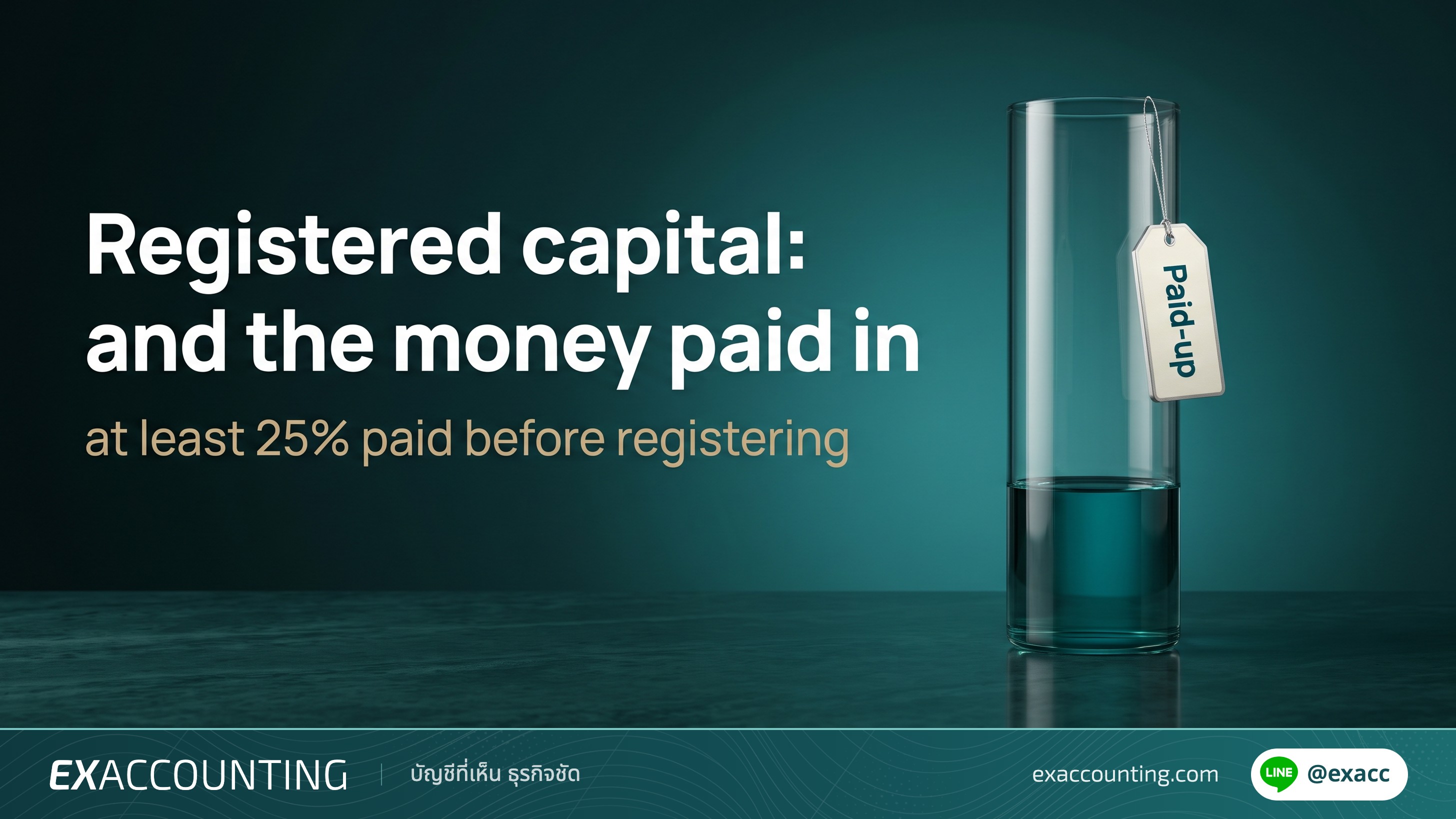
Thai registered capital need not be paid in full on day one, but at least 25% must be paid before registering. See paid-up capital and SME tax rules.
Registered capital is the amount stated in a company's memorandum of association and registered with the Department of Business Development, divided into shares of equal value. For example, 2,000,000 baht in capital divided into 20,000 shares of 100 baht. It is what the shareholders undertake to contribute, not money that must all be in place on registration day. The law requires at least 25% of the share value to be paid before registration, and sets no minimum capital in baht for an ordinary limited company.
Registered, paid-up and unpaid capital
| Meaning | Example: 2,000,000 baht capital, 25% paid | |
|---|---|---|
| Registered capital | Number of shares × par value, as registered | 2,000,000 baht |
| Paid-up capital | Share money actually paid into the company | 500,000 baht |
| Unpaid share capital | What the company can call for later | 1,500,000 baht |
Shareholders are liable for the company's debts only up to their own unpaid share capital. In this example, creditors can pursue the shareholders for at most 1,500,000 baht in total. Once shares are fully paid, that liability ends.
The legal minimums
- Par value of at least 5 baht per share.
- At least 2 promoters, each subscribing for at least 1 share.
- Before registering the company, the directors must call for at least 25% of the share value.
- Capital cannot later be reduced below one quarter of the total.
Regulated businesses, or companies with foreign investment, may face capital requirements under other laws. Check with the relevant regulator before setting capital.
How much capital to set
There is no right number for every business, but four points should decide it:
- Money the shareholders will really contribute: capital far above real money means shareholders owe unpaid share capital and remain liable for it.
- Start-up costs: paid-up capital is money the company can spend. If it is not enough, shareholders will have to lend to the company, which is another item needing evidence.
- Fees do not depend on capital: the 5,500 baht company registration fee is the same at any capital, so there is no reason to set low capital to save on fees.
- The 5 million baht line: capital over 5 million needs extra bank evidence, and paid-up capital over 5 million loses the SME tax rates (next section).
Capital and SME tax rates
A company or registered partnership with paid-up capital of no more than 5 million baht on the last day of the accounting period and revenue from sales and services of no more than 30 million baht gets stepped corporate income tax rates:
| Net profit | Qualifying SME | Other juristic persons |
|---|---|---|
| 0 to 300,000 baht | Exempt | 20% |
| 300,001 to 3,000,000 baht | 15% | 20% |
| Over 3,000,000 baht | 20% | 20% |
Note the test uses paid-up capital, not registered capital, measured on the last day of the accounting period. If you plan to call up more share capital or increase capital beyond 5 million, talk to your accountant first about which tax year it affects. Filing details are in PND 50.
Extra documents for capital over 5 million baht
Order No. 1/2567 of the Central Partnership and Company Registration Office requires extra evidence depending on how shares are paid:
- In cash: bank evidence that the directors or managing partner received the share money, with a confirmation letter, and after registration, bank evidence that the company received it, within 15 days.
- In property: the owner's letter confirming the transfer, with details, plus copies of title documents for registered property.
- In labour (partnerships only): a confirmation letter with evidence, such as a copy of an employment contract.
The same applies to a capital increase that takes total capital over 5 million baht.
What your accountant needs to see
Paid-up capital is one of the first lines in shareholders' equity on the statement of financial position. The accountant records the money actually received, debiting the bank and crediting share capital; uncalled capital is not recorded as cash. So they need:
- The company affidavit and shareholder list (Bor Or Jor 5) showing paid-up capital.
- Share payments into the company's bank account totalling the paid-up capital.
- For payment in property: transfer documents and the agreed value.
A common first-year closing problem is that the registration documents say the shares are paid, but no share money ever reached the company's account, or it went into a director's personal account instead. This is hard to fix after the fact. Transfer share money into the company account as soon as it is opened and send the evidence to your accountant from the first month.
Increasing or reducing capital later
- It requires a special resolution of shareholders: at least three quarters of the votes of shareholders present and entitled to vote.
- New shares must first be offered to existing shareholders in proportion to their holdings.
- Registering a capital increase or reduction costs 500 baht each time.
Can you do it yourself?
Setting capital at registration is the shareholders' decision, and you can make it yourselves. What an accountant helps with is tying the capital figure to money actually received, and checking the effect on SME tax rates before calling up more capital or increasing it. EXACCOUNTING handles capital increases and reductions (meeting notices, newspaper notice, Bor Or Jor 5 filing); see prices on our pricing page. If you are still registering the company, see the full steps in registering a Thai limited company.
FAQ
What is the minimum registered capital for a Thai company?
The law sets no minimum in baht for an ordinary limited company. It only requires par value of at least 5 baht, 2 promoters holding at least 1 share each, and at least 25% paid before registration.
With 1 million baht registered capital, do I need 1 million in cash?
Before registration at least 25%, or 250,000 baht, must be paid. The rest can remain unpaid, but shareholders stay liable for it until it is paid in full.
Does higher capital mean higher registration fees?
No. Company registration fees are fixed, but capital over 5 million baht requires extra bank evidence.
Is extra money shareholders put into the company counted as capital?
No. Unless share capital is called up or capital is increased, that money is a loan from the shareholder. Document the loan clearly and tell your accountant.
References
Checked 20 November 2026
- Civil and Commercial Code, Title 22 on partnerships and companies (Thai, consolidated on the DBD website)
- DBD: registering a limited company (Thai)
- Central Partnership and Company Registration Office Order No. 1/2567, capital over 5 million baht (Thai)
- Ministerial Regulation on fees for partnerships and limited companies B.E. 2569 (Thai)
- Revenue Department: corporate income tax guide for SMEs (Thai)
Want our accountants to look at this for you?
Add us on LINE and tell us about your business. Our assistant will ask a few basics before passing you to an accountant.