Trial balance: why accountants run it monthly and how to fix one
A trial balance checks that debits equal credits before the financial statements. See an example, how to find errors, and what it cannot catch.
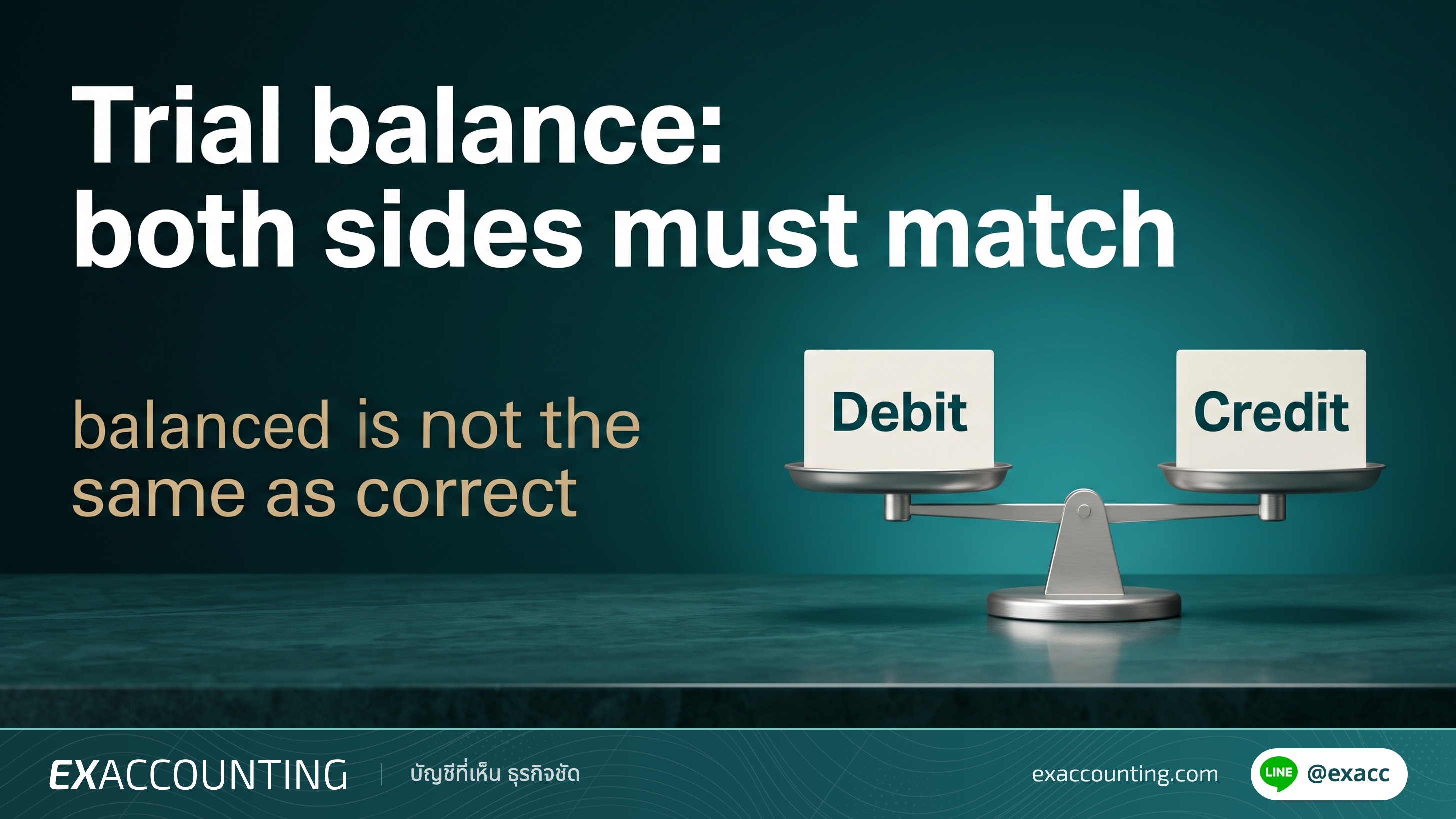
A trial balance is a table of the closing balance of every account in the general ledger on a given date, split into debit and credit columns. If double entry has been done correctly, both columns add up to the same total. Accountants use it to check the books every month and as the basis for the financial statements at year end. It is not filed with the Department of Business Development (DBD) or the Revenue Department, but auditors usually ask to see it.
Where does it come from?
- Every transaction is recorded in the journal, each with equal debits and credits.
- Journal amounts are posted to each account in the general ledger.
- Each account is balanced to show what remains on the debit or credit side.
- All balances are listed in chart of accounts order and each column is totalled.
An example
Continuing the design firm from the journal article, at 31 March after the client paid in full:
| Account | Debit | Credit |
|---|---|---|
| Bank | 215,000 | |
| Office equipment | 45,000 | |
| Accrued rent | 12,000 | |
| Share capital | 200,000 | |
| Service revenue | 60,000 | |
| Rent expense | 12,000 | |
| Total | 272,000 | 272,000 |
Each group has a normal side. Assets and expenses carry debit balances; liabilities, owners' equity and revenue carry credit balances. If an account sits on the wrong side, such as a bank account with a credit balance, check it first.
Three versions used at year end
- Unadjusted: after the period's ordinary entries, to check the initial balances.
- Adjusted: after period-end adjustments such as depreciation and accrued expenses. This is the basis for the financial statements.
- Post-closing: after revenue and expenses are closed to retained earnings, leaving only the balances carried into next year.
Many accountants use a six-column format: opening balance, movements in the period, and closing balance, each with debit and credit. It shows at a glance which accounts moved unusually that month. For the full year-end sequence, see closing the books for a Thai company.
The totals do not match. Where is the error?
- Re-add each column: sometimes it is just the sum.
- Find the difference: then look for an entry of that amount, which may have been recorded on one side only.
- If the difference divides by two: look for an entry equal to half of it, which may be on the wrong side.
- If the difference divides by nine: digits may be transposed, such as 720 typed as 270.
- Check opening balances: they must match last year's closing balances.
Balanced does not mean correct
A trial balance only catches errors that make the two sides unequal. These pass straight through:
- Posting to the wrong account, such as repairs recorded as advertising
- Leaving out a transaction entirely, or recording it twice
- The same wrong amount on both sides
- Missing adjustments, such as no depreciation
So accountants also check some accounts against outside evidence: bank balances against statements, receivables and payables against customer and supplier lists, and output and input VAT against the tax returns filed.
How owners can use it
Owners do not need to prepare a trial balance, but you can ask to see it every month and ask a few simple questions that catch problems before year end:
- Does the bank balance match the month-end statement?
- Which receivables are overdue, and are they still collectable?
- Is anything sitting in a suspense or "to be checked" account? If so, which missing document caused it?
- Did any expense group jump unusually from last month?
Can you do it yourself?
If you use accounting software and record every journal entry, the software produces the trial balance for you. The hard part is checking that each balance is actually right, not just that the sides agree, which means reconciling against bank statements, tax reports and customer and supplier lists every month. If you want our bookkeeping team to close and check each month, see the scope on our pricing page.
FAQ
Do we submit the trial balance to the DBD?
No. You submit financial statements. The trial balance is an internal working paper, though auditors usually ask for it.
How often should a trial balance be prepared?
Every month at period close, to catch errors early, and again after year-end adjustments before preparing the financial statements.
How is a trial balance different from financial statements?
A trial balance lists every account in detail to check accuracy. Financial statements group those balances into the lines of the DBD format for outside readers.
References
Checked 20 November 2026
Want our accountants to look at this for you?
Add us on LINE and tell us about your business. Our assistant will ask a few basics before passing you to an accountant.