50 Tawi: how to fill in a Thai withholding tax certificate
The 50 Tawi certificate is what a payer gives the payee after withholding Thai tax. See each field, how many copies, when to issue it, and how tax borne by the payer works.
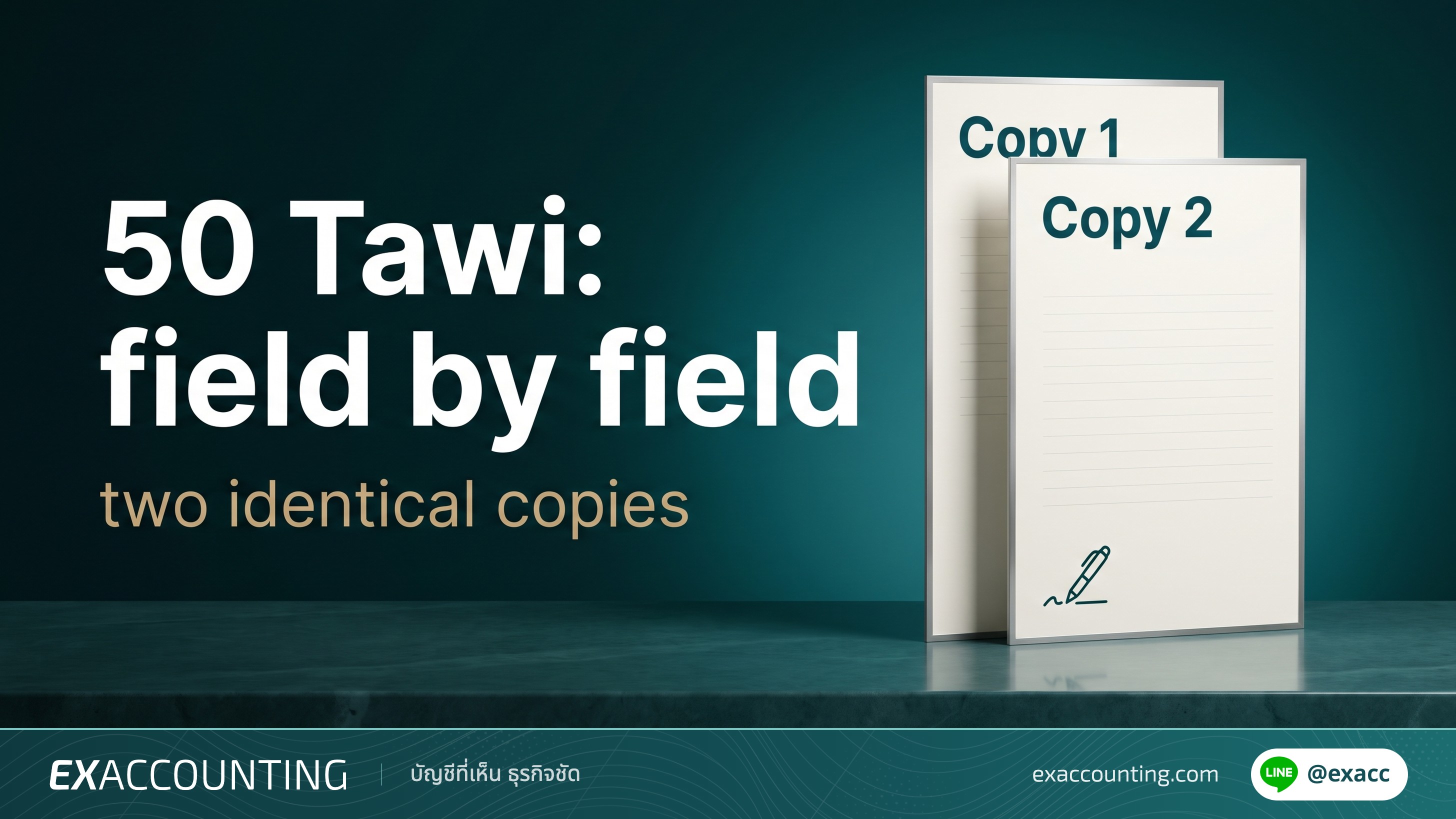
The 50 Tawi (50 ทวิ) is the withholding tax certificate required by Section 50 bis of the Thai Revenue Code. A payer who withholds tax must give the payee two identical copies, so the payee can claim the withheld amount as a credit in their own income tax return. For service fees, rent, transport, advertising and contract work, you issue it every time you withhold. For employee salaries, you issue it once a year by 15 February of the following year.
Who issues it and who keeps it?
The party that withholds the tax issues the certificate, not the party that receives the money. If your company hires a freelancer and withholds 3%, your company issues the 50 Tawi to the freelancer. If a customer withholds from your invoice, the customer owes you one.
The form has two copies, each printed with its own header:
- Copy 1: for the payee to attach to their tax return
- Copy 2: for the payee to keep as evidence
Both copies go to the payee. Keep your own copy with that month's accounting documents, because the amounts on your certificates must match the PND 3 or PND 53 you file for the month.
When must you issue it?
- Service fees, rent, transport, advertising, contract work and other items filed on PND 3 or PND 53: issue it immediately each time you withhold.
- Salaries, wages and commissions (filed on PND 1): issue it by 15 February of the following year, or within one month after an employee leaves during the year.
Many companies send the 50 Tawi as a PDF on the same day as the payment, so nothing needs chasing later.
Filling it in, field by field
- Book No. / No.: your own running number for the certificate.
- Withholding agent: name, address and 13-digit tax ID of the payer. A company uses its company registration number.
- Person subject to withholding: name, address and 13-digit ID of the payee. Individuals use their national ID number; companies use their registration number.
- Sequence No. … in form: the payee's line number in your monthly filing, and a tick for the form it appears in. The options are PND 1A, PND 1A special, PND 2, PND 3, PND 2A, PND 3A and PND 53.
- Type of income paid: pick the row that matches the payment.
- Row 1 salaries and wages · row 2 fees and commissions · row 3 royalties · row 4 interest and dividends
- Row 5 is the one companies use most. It covers payments under the Revenue Department's withholding order, such as service fees, contract work, rent, advertising, transport, prizes and sales-promotion discounts.
- Row 6 is "other" and must be described.
- Date paid · amount paid · tax withheld: the actual payment date, the amount before tax, and the tax withheld.
- Total tax withheld (in words): the tax amount written out in Thai words.
- Fund contributions: for salary payments only, the social security and provident fund amounts deducted from the employee. Leave blank otherwise.
- Payer: tick (1) withheld at source, (2) tax borne by payer on every round, (3) tax borne by payer once, or (4) other. Most payments are (1).
- Signature and date: signed by an authorised person of the payer, with the company seal if you use one.
Hypothetical example: a company hires a freelancer to design a logo for 10,000 baht on 5 March 2026 and withholds 3%. The payee section shows the freelancer's name and national ID, PND 3 is ticked, income type is row 5, amount paid is 10,000 baht, tax withheld is 300 baht, and the payer box is (1). The company then remits the 300 baht on its March PND 3.
The rate for each type of payment is in Thai withholding tax rates. If you are unsure which form a payee belongs on, see PND 3 vs PND 53.
What "tax borne once" and "tax borne on every round" mean
Both options mean the payer carries the tax for the payee, who receives the full amount. Under Revenue Department Order Por. 7/2528, tax paid on someone's behalf is itself income of the payee, so the calculation differs from ordinary withholding.
- Borne once: the payer pays the tax one time, calculated on the payment plus that tax.
- Borne on every round: the payer covers all tax, including the tax on the tax, so the amount is grossed up until the payee owes nothing more.
Hypothetical example (service fee of 10,000 baht at 3%):
- Ordinary withholding: tax 300 baht, payee receives 9,700 baht
- Borne once: tax (10,000 + 300) × 3% = 309 baht, payee receives 10,000 baht
- Borne on every round: tax 10,000 × 3/97 ≈ 309.28 baht, payee receives 10,000 baht
If you agree to bear the tax, write it into the contract or quotation from the start and have your accountant check the calculation before filing.
Do you need a 50 Tawi when paying through e-Withholding Tax?
No, not for payments made through the e-Withholding Tax system. The bank remits the tax with the transfer and sends electronic evidence to both sides in place of the certificate, and those payments are not filed on PND 3 or PND 53. From 1 January 2026 to 31 December 2027, rates of 5%, 3% and 2% are also reduced to 1% for payments made through the system. You must tell a participating bank at the time of the transaction; an ordinary transfer followed by a normal filing does not count.
Common mistakes
- Entering the net amount as "amount paid": this field is the amount before tax, 10,000 and not 9,700.
- Ticking the wrong form: an unregistered ordinary partnership or a body of persons goes on PND 3, not PND 53.
- A 13-digit ID that does not match the payee's documents: the payee may be unable to claim the credit.
- Issuing all certificates at year end: the law requires immediate issue. If you missed one, issue it based on the real payment date rather than changing dates.
A withholding agent who fails to issue the certificate faces a criminal penalty under Section 35 of the Revenue Code, as printed at the bottom of the form.
Can you do it yourself?
Yes, if you only make a few payments a month. The form is on the Revenue Department website and most accounting software can print it. The key check is that all certificates for a month add up to the form you file. If you pay many payees of different types, our tax team can keep documents and filings in sync. For the full picture, see what Thai withholding tax is.
FAQ
How many copies of the 50 Tawi are needed?
Two identical copies, both for the payee: copy 1 to attach to their return and copy 2 to keep. The payer keeps its own copy with its accounting records.
Can I send the 50 Tawi as a PDF?
In practice yes, as long as it contains all fields of the form and is signed by an authorised person.
The payee lost the certificate. What now?
Ask the payer to issue a new one with the same information. The date and amounts must match what the payer filed.
A customer withheld tax but never sent a 50 Tawi. What can I do?
Ask the customer for it, citing the payment date and amount withheld. You need the certificate as evidence to claim the credit in your income tax return, such as PND 50.
References
Checked 19 November 2026
- Revenue Department: 50 Tawi certificate form (Thai)
- Revenue Department: Director-General notification No. 62 on the certificate form (Thai)
- Revenue Department: Order Por. 7/2528 on tax borne by the payer (Thai)
- Revenue Department: SME guidelines, e-Withholding Tax (Thai)
- Revenue Department: press release 14/2569 extending e-Withholding Tax (Thai)
Want our accountants to look at this for you?
Add us on LINE and tell us about your business. Our assistant will ask a few basics before passing you to an accountant.