Chart of accounts in Thailand: the five groups and how to set codes
A chart of accounts lists every account with its code. See the five groups, multi-level codes, accounts a small Thai business needs, and what not to change.
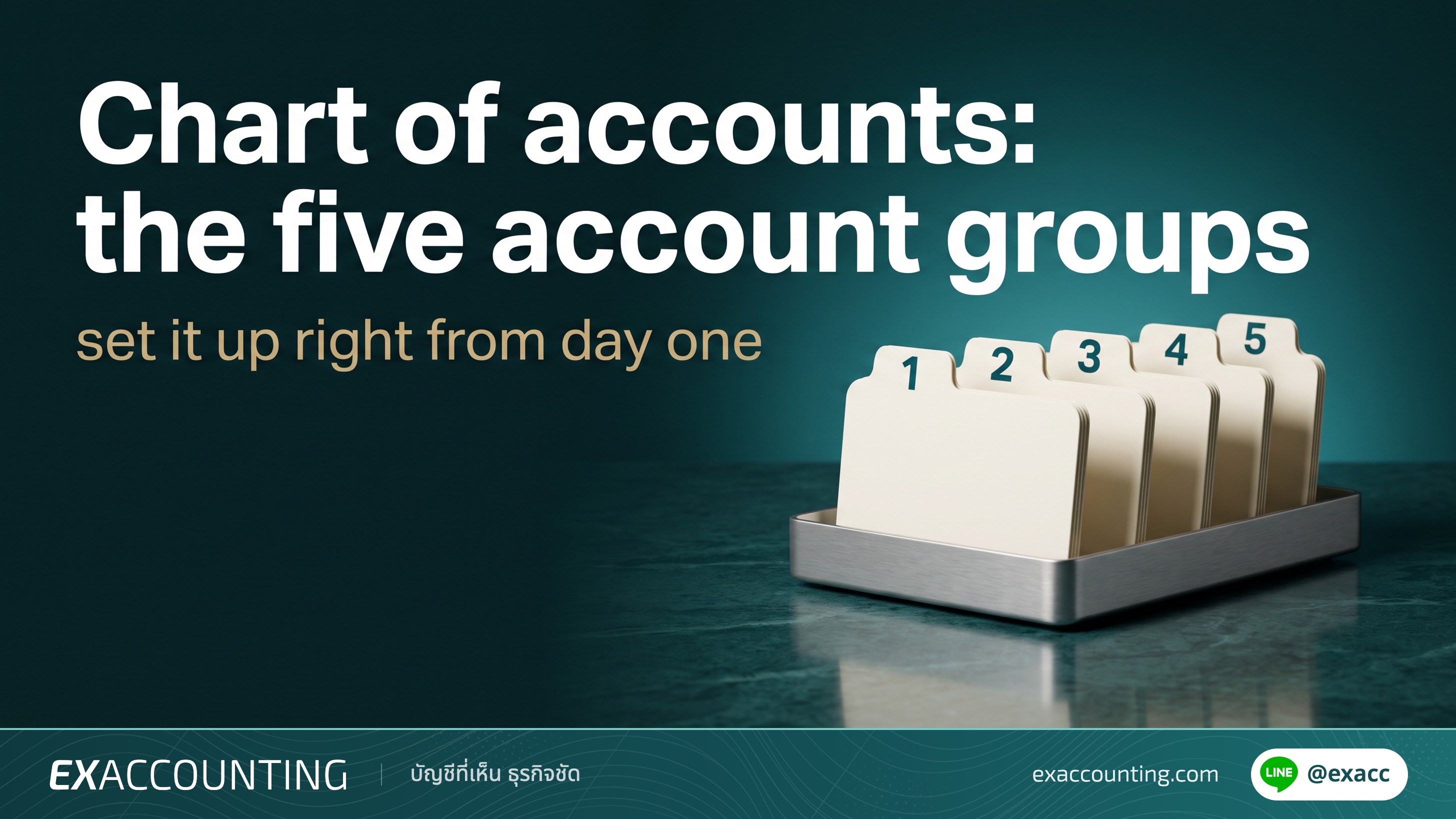
A chart of accounts is the list of every account a business uses to record transactions. Each account has its own code and belongs to one of five groups: assets, liabilities, owners' equity, revenue and expenses. The first three make up the statement of financial position; the last two make up the income statement. When recording the journal, the accountant picks accounts from this list, and at year end each account's balance rolls up into a line in the financial statements.
The five groups
The groups come from the elements of financial statements under TFRS for NPAEs. Most Thai charts use the first digit of the code to show the group:
- 1 Assets: cash, bank deposits, trade receivables, inventory, equipment, vehicles
- 2 Liabilities: trade payables, accrued expenses, withholding tax payable, loans
- 3 Owners' equity: share capital or partners' capital, legal reserve, retained earnings
- 4 Revenue: sales, service income, interest income
- 5 Expenses: cost of sales, salaries, rent, depreciation, interest expense, income tax
Using 1 to 5 as the leading digit is a common convention, not a legal requirement, but it lets anyone read the group from the code and makes reports easy to group.
Why multi-level codes help
Charts that last are usually layered: upper levels are headings that take no entries, and the lowest level holds the accounts actually used. A 4-digit example:
- Group: 1000 Assets (no entries)
- Sub-group: 1100 Cash and cash equivalents (no entries)
- Account: 1110 Petty cash · 1120 Savings account, Bank A · 1121 Current account, Bank B (entries allowed)
If sub-groups match the lines in the financial statements under the Department of Business Development (DBD) minimum line items, such as cash and cash equivalents, trade and other current receivables, inventories, and property, plant and equipment, the accountant can roll balances into the statements at year end without regrouping. The law sets no number of digits. Four digits suit a small business; businesses with several branches or projects often use six or more.
Accounts a small business should have from day one
- Petty cash, and a separate code for each bank account
- Trade receivables and trade payables
- Input VAT and output VAT, if VAT-registered
- Withholding tax payable and social security payable, if you have staff or hire services
- Accrued expenses, for period-end adjustments
- Loans from directors, if the owner puts personal money into the business
- Capital and retained earnings
- Main revenue by business line, and other income
- Cost of sales, staff costs, rent, utilities, depreciation
Rules for a chart that lasts
- Start from a standard chart and add only what you need: too many accounts make mis-postings easy.
- Leave gaps in the numbering: so new accounts fit without renumbering.
- Avoid overlapping names: for example, do not have both "sundry expenses" and "other expenses".
- Do not change the code or group of an account that already has entries: past reports refer to it.
- Deactivate accounts you no longer use: instead of deleting them.
Where owners come in
You do not need to build the chart yourself, but tell your accountant how you want to see the numbers, because the chart decides how far reports can be broken down. For example:
- Profit by branch, sales channel or product line
- Online marketing separate from general advertising
- Running costs per vehicle or machine
If you say so at the start of the year, the accountant can set up sub-accounts. If you ask at year-end closing, a whole year of entries has to be split retrospectively.
What happens to the chart when you change accounting firm?
The chart is tied to opening balances and past reports. If you change bookkeeper mid-year, you should receive the existing chart and a trial balance at the handover date so balances carry over. If the new firm uses its own chart, there must be a mapping from old codes to new codes, and the trial balance before and after the move must have the same totals. For the handover steps, see changing your accounting firm.
Can you do it yourself?
Yes, if your accounting software comes with a standard chart and you add only bank accounts and the sub-accounts you need. Take care with mapping accounts to financial statement lines and with changing the chart after entries exist. If you want our bookkeeping team to set up a chart that fits your business and maintain it monthly, see the scope on our pricing page.
FAQ
How many groups are in a chart of accounts?
Five: assets, liabilities, owners' equity, revenue and expenses.
How many digits should account codes have?
The law does not say. Four to six digits are common, with the first digit showing the group. More complex businesses need more digits for more levels.
Do partnerships and companies use different charts?
The five-group structure is the same. The difference is in owners' equity: companies use share capital, while partnerships use partners' capital.
Can we add accounts mid-year?
Yes. Adding an account does not affect existing entries. What you should avoid is changing the code or group of an account that already has entries.
References
Checked 20 November 2026
Want our accountants to look at this for you?
Add us on LINE and tell us about your business. Our assistant will ask a few basics before passing you to an accountant.