Thai limited company or limited partnership: what differs and which to choose
Thai companies and limited partnerships pay the same corporate tax. They differ in owner liability, fees, audits and annual paperwork. Compare them and decide.
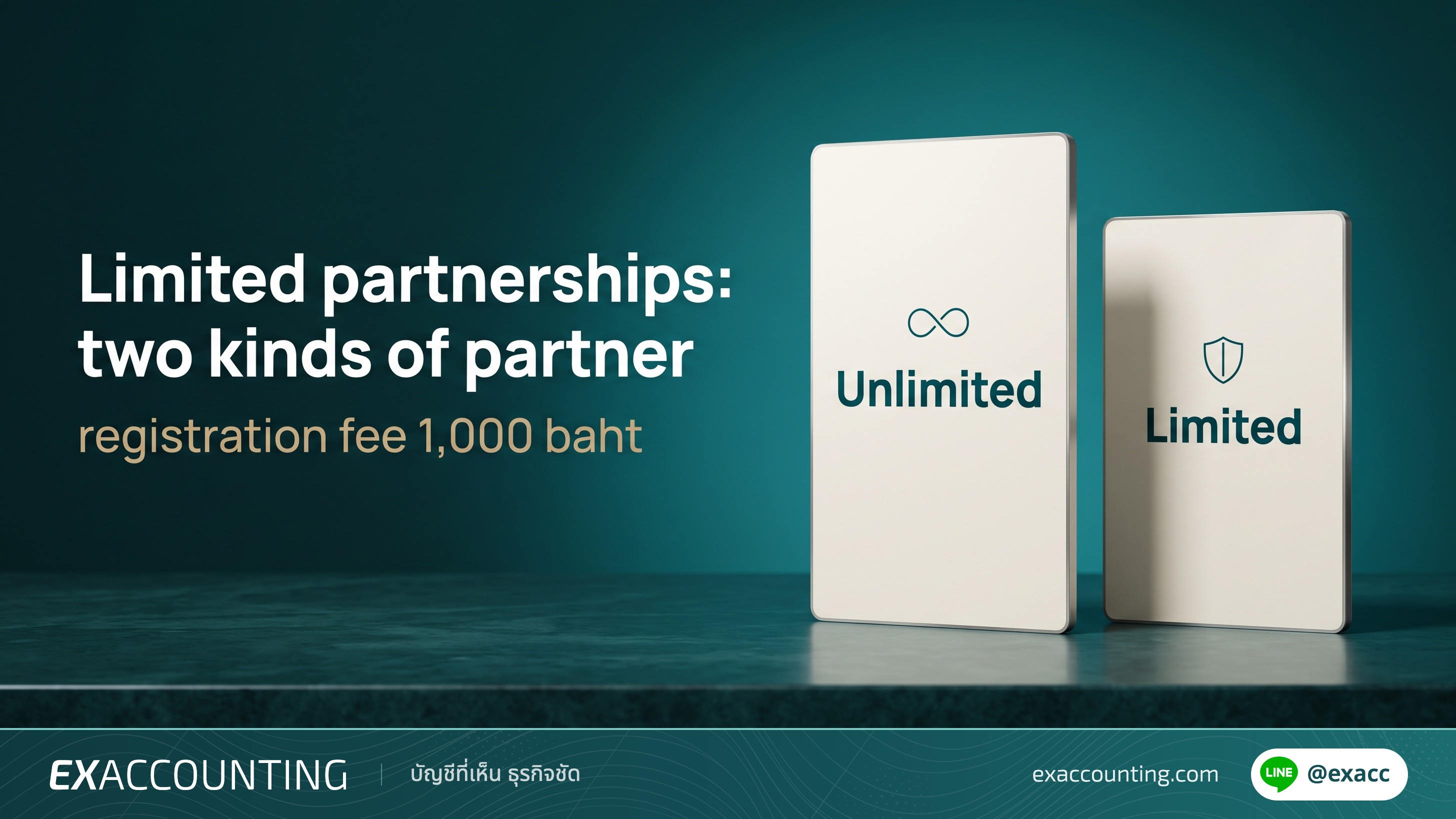
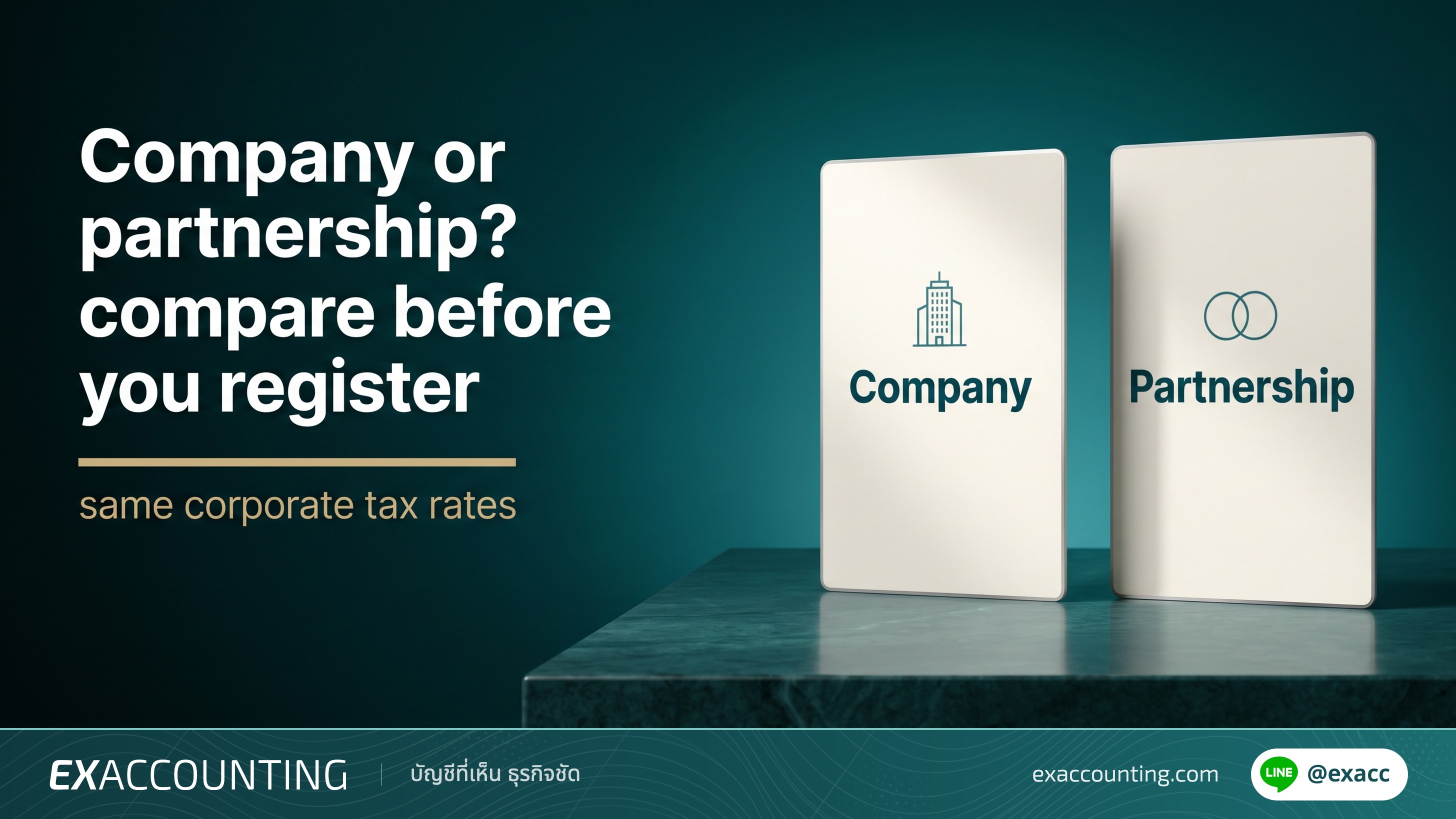
Thai limited companies and limited partnerships are both juristic persons. Both keep books, file financial statements and pay corporate income tax at the same rates, so tax is no reason to choose one. Three differences really matter: owner liability (a partnership needs a managing partner with unlimited liability for its debts), annual cost (a company needs a licensed auditor every year; a small partnership does not) and registry work (a company must hold shareholders' meetings and file Bor Or Jor 5). Registration costs 5,500 baht for a company and 1,000 baht for a partnership.
Side-by-side comparison
| Topic | Limited company | Limited partnership |
|---|---|---|
| Minimum people | 2 promoters | 2 partners (1 unlimited-liability + 1 limited-liability) |
| Liability for debts | Every shareholder liable only up to unpaid share capital | Unlimited-liability partners liable for all debts |
| Management | Directors, as many as the meeting decides | Managing partner, who must be an unlimited-liability partner |
| Registration fee | 5,500 baht | 1,000 baht |
| Audit | Licensed auditor every year | A small partnership needs no licensed auditor, but PND 50 needs a tax auditor's certification under section 3 septem |
| Meetings and registry | Annual general meeting every 12 months · share register · Bor Or Jor 5 filing | No statutory shareholders' meeting |
| Financial statement deadline | Approved within 4 months of year end, filed within 1 month of approval | Within 5 months of year end |
| Corporate income tax | Same rates | Same rates |
A small partnership in the audit row has registered capital of up to 5 million baht, total assets up to 30 million and total revenue up to 30 million. Filing deadlines are explained in filing financial statements on DBD e-Filing.
Same tax, so do not choose on tax
A company or registered partnership with paid-up capital of no more than 5 million baht on the last day of the accounting period and revenue from sales and services of no more than 30 million baht gets the same SME rates: the first 300,000 baht of net profit is exempt, 300,001 to 3,000,000 baht is taxed at 15%, and the excess over 3,000,000 baht at 20%. Monthly taxes such as VAT and withholding tax are also the same for both.
The tax question worth asking is whether to become a juristic person at all or stay an individual, covered in personal vs corporate income tax.
The annual costs that really differ
Registration fees are paid once. What recurs every year is what you should compare.
- Audit fees: a company hires a certified public accountant (CPA) every year. A small partnership can use a tax auditor (TA). Fees vary with business size; ask auditors directly.
- Company registry work: an annual general meeting and Bor Or Jor 5 filing every year, plus updating the share register and filing when shares are transferred.
- Work that is the same: monthly bookkeeping, monthly tax, year-end closing, and PND 50 and PND 51. The workload depends on the number of transactions, not the legal form.
Three questions to help decide
1. Is anyone ready to be liable for the business's debts with personal assets? A partnership needs at least one managing partner with unlimited liability. If the business could take on large debts, such as bank loans, contracting work or long supplier credit, that risk should outweigh the registration fee you save.
2. Will you bring in more investors later? A company takes on new shareholders and transfers shares more systematically, and increases capital by special resolution. A partnership of family members with no plan to bring in outsiders can live with a simpler structure.
3. What do customers and partners expect? Some clients require a company, or want statements certified by a licensed auditor. If your main customers are like that, starting as a company is easier than converting later.
Can a partnership become a company later?
Yes. A partnership can register a conversion into a limited company for a 5,000 baht fee under the Ministerial Regulation on fees B.E. 2569. So a small business can start as a partnership and convert as it grows, but conversion has its own paperwork and closing entries, so plan it with your accountant.
Can you do it yourself?
Choosing the form is the owner's decision, and the table gives enough to decide. What is worth discussing with an accountant is a realistic estimate of each form's annual cost for your size of business, and if you are still trading as an individual, when to incorporate. Our advisory team can work through the numbers from your real data. Once you have chosen, the steps are in registering a Thai limited company and registering a Thai limited partnership.
FAQ
Do companies and partnerships pay different tax?
No. Both pay corporate income tax at the same rates and get the same SME rates if paid-up capital is no more than 5 million baht and revenue no more than 30 million baht.
Does a limited partnership need an auditor?
A small partnership under the thresholds does not need a licensed auditor, but its PND 50 still needs a tax auditor's report under section 3 septem.
Can a company have just one director?
Yes. A company can have as many directors as the meeting decides, but it needs at least 2 promoters at formation.
What does it cost to convert a partnership into a company?
The conversion registration fee is 5,000 baht.
References
Checked 20 November 2026
- Civil and Commercial Code, Title 22 on partnerships and companies (Thai, consolidated on the DBD website)
- DBD: handbook for newly registered juristic persons (Thai)
- Ministerial Regulation on fees for partnerships and limited companies B.E. 2569 (Thai)
- Revenue Department: corporate income tax guide for SMEs (Thai)
- DBD: registering registered ordinary partnerships and limited partnerships (Thai)
- DBD: registering a limited company (Thai)
Want our accountants to look at this for you?
Add us on LINE and tell us about your business. Our assistant will ask a few basics before passing you to an accountant.