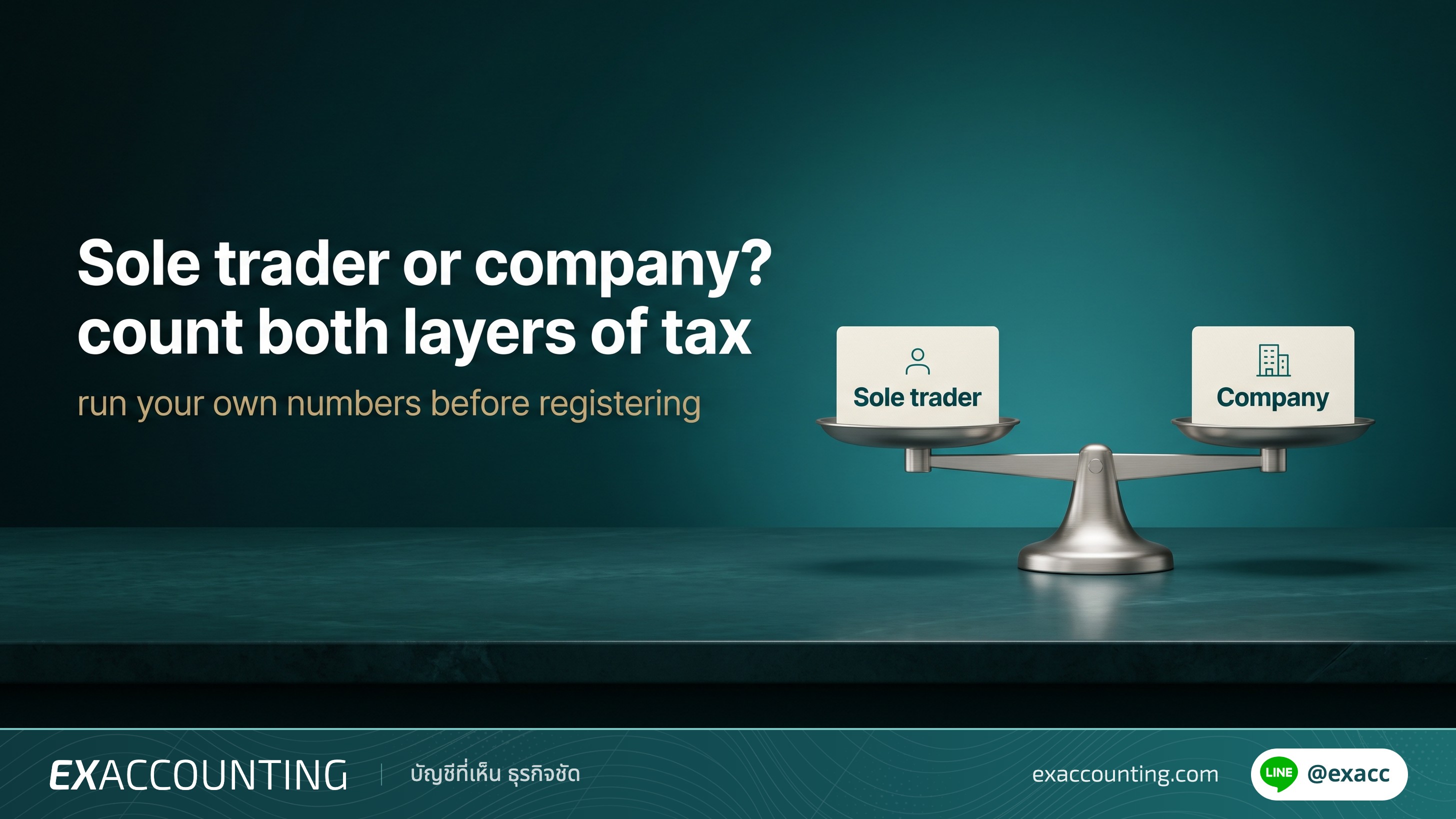
Sole trader vs company in Thailand: how the tax differs, and does a company really pay less?
Thai personal tax at 0 to 35% vs SME company tax at 0, 15 and 20%, plus the second layer when money leaves the company, three examples, and extra duties.
If you trade in your own name, the business profit is your income and is taxed once at personal progressive rates of 0 to 35%. If you register a company or juristic partnership, the business pays corporate income tax: for an SME, the first 300,000 baht is exempt and 15% applies up to 3 million baht. But money the owner takes out, as salary or dividends, is taxed again. So a company does not always mean less tax. It depends on the profit level, how you take money out, and the extra accounting costs.
One layer of tax: trading in your own name
Business income in your own name is 40(8) income. You deduct a flat 60% if it is one of the 43 types listed by the Revenue Department, or actual expenses, then allowances, and apply these bands:
| Net income (baht) | Rate | Cumulative tax at top of band |
|---|---|---|
| 0 to 150,000 | Exempt | 0 |
| 150,001 to 300,000 | 5% | 7,500 |
| 300,001 to 500,000 | 10% | 27,500 |
| 500,001 to 750,000 | 15% | 65,000 |
| 750,001 to 1,000,000 | 20% | 115,000 |
| 1,000,001 to 2,000,000 | 25% | 365,000 |
| 2,000,001 to 5,000,000 | 30% | 1,265,000 |
| Above 5,000,000 | 35% |
You file PND 94 mid-year and PND 90 at year end. For independent workers, see Thai freelance income tax.
Two layers of tax: trading through a company
Layer one: the company's tax
| Net profit (baht) | SME | Other companies |
|---|---|---|
| 0 to 300,000 | Exempt | 20% |
| 300,001 to 3,000,000 | 15% | 20% |
| Above 3,000,000 | 20% | 20% |
An SME here is a juristic entity with paid-up capital of no more than 5 million baht on the last day of the accounting period and revenue from sales and services of no more than 30 million baht. For how the company files, see corporate income tax on PND 50.
Layer two: tax when money moves from the company to the owner
- Director salary: an expense of the company, so it reduces the profit subject to corporate tax, but it is 40(1) income for the director and taxed as personal income.
- Dividends: paid from the company's after-tax profit. The recipient can accept 10% withholding as final, or include them in income and use the dividend tax credit.
- Company money is not the owner's money: taking it for personal use has to go through salary, dividends or a documented transaction.
Example: a 1,200,000 baht profit, three ways
Assume revenue of 4,000,000 baht, actual documented expenses of 2,800,000 baht, the owner has only the personal allowance, the company qualifies as an SME, and all profit is taken out. Accounting fees, audit fees and social security are excluded.
| Own name | Company, all as dividends | Company, 600,000 director salary then dividends | |
|---|---|---|---|
| Personal tax on profit or salary | 150,000 | 21,500 | |
| Corporate tax | 135,000 | 45,000 | |
| Dividend tax at 10% | 106,500 | 55,500 | |
| Total tax | 150,000 | 241,500 | 122,000 |
How the figures are built:
- Own name: 1,200,000 less the 60,000 allowance leaves 1,140,000. Tax is 115,000 plus 140,000 × 25%. The 0.5% method gives 20,000, which is lower, so the normal method applies.
- All dividends: corporate tax is 900,000 × 15%, leaving 1,065,000 after tax, with 10% withheld on the dividend.
- Salary plus dividends: company profit falls to 600,000, so tax is 300,000 × 15%, leaving 555,000 paid out with 10% withheld. The 600,000 salary less the 100,000 expense deduction and 60,000 allowance leaves 440,000, taxed at 21,500.
The point is that a company is not automatically cheaper. Paying all profit out as dividends with the 10% final withholding costs more than trading in your own name. (Including the dividends in your income and claiming the dividend tax credit under Section 47 bis brings the total down to about 150,000 baht, the same as trading in your own name.) Splitting it between a reasonable salary and dividends can cost less. Real results depend on each owner's expenses, allowances and plans for taking money out, so ask an accountant to run your own numbers before you decide.
What changes once you are a juristic entity
| Item | Own name | Company or juristic partnership |
|---|---|---|
| Annual tax return | PND 90, plus PND 94 mid-year | PND 50, plus PND 51 mid-year |
| Expense deduction | Flat rate allowed for the 43 types | Actual only, with documents |
| Financial statements | Not filed with the DBD | Books kept and statements filed every year, even with no revenue |
For the financial statement duty, see filing financial statements with the DBD. For choosing between a limited company and a partnership, see company or partnership.
Signs it is time to talk about a company
- Your net income is reaching the 25% band or higher
- Actual expenses exceed the flat rate, or your work is not one of the 43 types, and you keep full expense records
- Large clients want to deal with a juristic entity
- You do not need to take all the profit out every year
- You are ready to keep proper books every month and budget for accounting and audit fees
Can you do it yourself?
You can do a first comparison yourself with the tables in this article, but the real decision is worth making with an accountant. It depends on which expenses the company can actually deduct, a reasonable director salary, social security, and the accounting costs you will carry every year. Our advisory service can run the numbers both ways before you decide, and once you are registered, see the scope of monthly bookkeeping on our pricing page.
FAQ
Does a company always pay less tax?
No. An SME company is exempt on the first 300,000 baht of profit and pays 15% up to 3 million baht, but the owner pays tax again on salary or dividends, and accounting and audit fees are added. The overall result depends on the profit level and how money is taken out.
How is an unincorporated shop owner taxed?
Take the year's revenue, deduct expenses (a flat 60% if the business is one of the 43 types, or actual), deduct allowances, then apply the 0 to 35% progressive rates. File PND 94 mid-year and PND 90 at year end.
Once I have a company, can I take company money for personal use?
Company money is separate from yours. It has to come out through salary, dividends or a documented transaction. Simply withdrawing it leaves the books wrong and can lead to tax issues.
References
Checked 20 November 2026
Want our accountants to look at this for you?
Add us on LINE and tell us about your business. Our assistant will ask a few basics before passing you to an accountant.