e-Withholding Tax in Thailand: the 1% rate and how it works
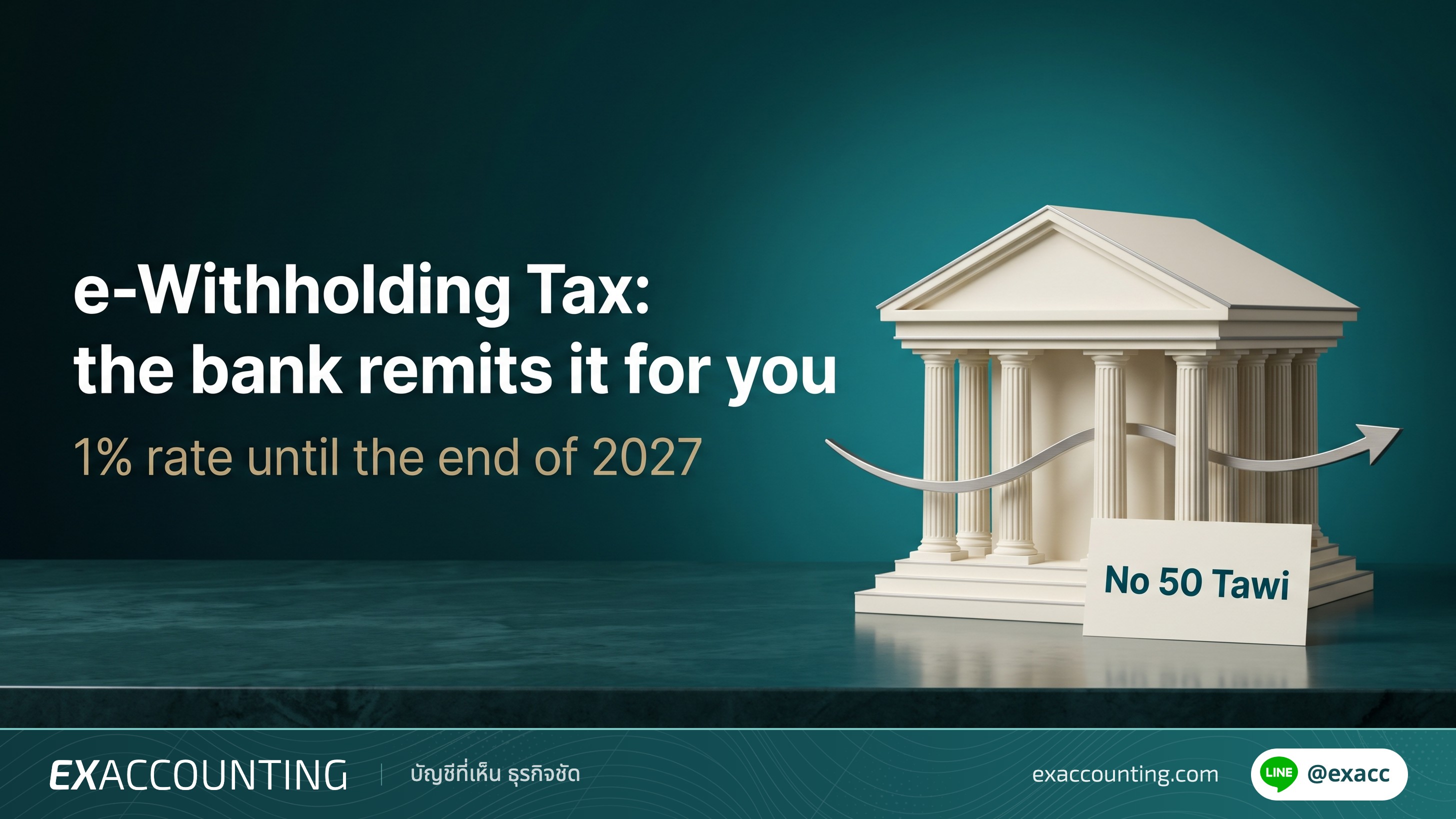
With e-Withholding Tax the bank withholds and remits for you. 5%, 3% and 2% rates drop to 1% until 31 December 2027, with no 50 Tawi. How to use it.
e-Withholding Tax, or e-WHT, lets a bank that takes part in the Revenue Department's scheme withhold and remit withholding tax for you. You make the transfer and declare the tax details, the bank pays the net amount to the payee, and the bank sends the tax and the data to the Revenue Department. The clearest benefit right now is that the 5%, 3% and 2% rates drop to 1% for income paid through the system from 1 January 2026 to 31 December 2027, and you issue no 50 Tawi and file no PND form for that payment. The system is optional, not mandatory.
What the 1% rate applies to
The Cabinet resolved on 16 June 2026 to extend the 1% rate, which follows an earlier round in 2023 to 2025, and the ministerial regulation has been published in the Royal Gazette. It applies to payments made through the system from 1 January 2026 to 31 December 2027.
| Payment | Normal rate | Through e-WHT, 2026 to 2027 |
|---|---|---|
| Rent of property | 5% | 1% |
| Prizes from contests or lucky draws | 5% | 1% |
| Services, contract work, contracting | 3% | 1% |
| Professional fees | 3% | 1% |
| Advertising | 2% | 1% |
| Transport | 1% | 1%, unchanged |
If the payee is a foundation or association, many items normally carry 10% under Order Tor. Por. 4/2528, so check before applying the reduced rate. The full list is in Thai withholding tax rates.
How the money moves
- You transfer through your bank's e-WHT service and declare the tax details with the transfer.
- The bank withholds the tax, pays the net amount to the payee, and sends electronic proof of tax payment to both of you, for example by SMS.
- The bank remits the tax and data to the Revenue Department within 4 business days after receiving the money.
- Both the payer and the payee can log in to the Revenue Department's system to check their transactions.
What to declare when transferring
- Your company's tax ID
- The payee's name or tax ID
- Income type, amount paid and VAT, if any
- The tax withheld
- The payee's contact details, so the bank can send them the proof
This is the same information you would need for a 50 Tawi. If it is kept in your supplier records from the start, an e-WHT transfer takes little longer than a normal one.
What you gain and what to watch
You gain:
- No 50 Tawi: the bank's proof replaces it under Director-General Notification No. 20. See what a 50 Tawi is.
- No duplicate filing: payments fully remitted through e-WHT do not go on PND 3 or PND 53.
- More cash for the payee: 1% is withheld instead of 3% or 5% during 2026 to 2027.
- Foreign payments too: it works for Sections 70 and 70 bis, but the 15% and 10% rates on foreign payments are not reduced. See PND 54.
Watch out for:
- Choosing e-WHT at the time of transfer: a normal transfer cannot be converted afterwards.
- Declaring the wrong tax amount: if too little was remitted, you must remit the difference yourself through the Revenue Department's electronic system.
- Different channels and fees at each bank: check with your company's bank first.
- Payees keeping the bank's proof: they need it to claim the tax credit on their annual return.
What to tell your accounting firm
If your accounting firm files PND 3 and PND 53 for you, it must know clearly which payments went through e-WHT. Otherwise they may be filed twice, or the firm may wait for a 50 Tawi that will never exist. Each month, send:
- The bank's e-WHT transaction report for the month.
- The bills or tax invoices for those payments, to record the expense and input VAT.
- Payments where customers withheld from you through e-WHT, with the bank's proof. That tax is a credit against your corporate income tax, and it can be checked in the Revenue Department's system.
Can you do it yourself?
Yes, and if your bank already offers it, e-WHT usually means less work, since there are no certificates to issue and no return to file for those payments. What still needs care is choosing the right income type and rate at the time of transfer, and reconciling each month which payments went through the bank and which you must file yourself. Our tax team can set up how to separate them and file the rest. See the scope on our pricing page.
FAQ
Until when does the 1% e-WHT rate apply?
To income paid through e-WHT from 1 January 2026 to 31 December 2027.
Do I issue a 50 Tawi when using e-WHT?
No. Director-General Notification No. 20 makes the bank's electronic proof the evidence of withholding and exempts you from issuing a 50 Tawi.
How does the payee know tax was withheld?
The bank sends electronic proof, such as an SMS, and the payee can check the transaction in the Revenue Department's system.
Can a supplier refuse e-WHT?
e-WHT is the payer's choice. If you do not use it, withhold at the normal rate, issue a 50 Tawi and file the return yourself as usual.
References
Checked 20 November 2026
- Revenue Department: press release 14/2569 extending e-Withholding Tax (Thai)
- Revenue Department: ministerial regulation reducing e-Withholding Tax rates, 15 October 2026 (Thai)
- Revenue Department: Director-General Notification No. 20 on electronic tax remittance (Thai)
- Revenue Department: seminar slides on e-Withholding Tax and certificates (Thai)
- Revenue Department: Order Tor. Por. 4/2528 (Thai)
Want our accountants to look at this for you?
Add us on LINE and tell us about your business. Our assistant will ask a few basics before passing you to an accountant.