PV, RV and JV: the vouchers behind every bill in Thai bookkeeping
PV, RV and JV are payment, receipt and journal vouchers used to record entries. See when to use each, what to attach and how long to keep them.
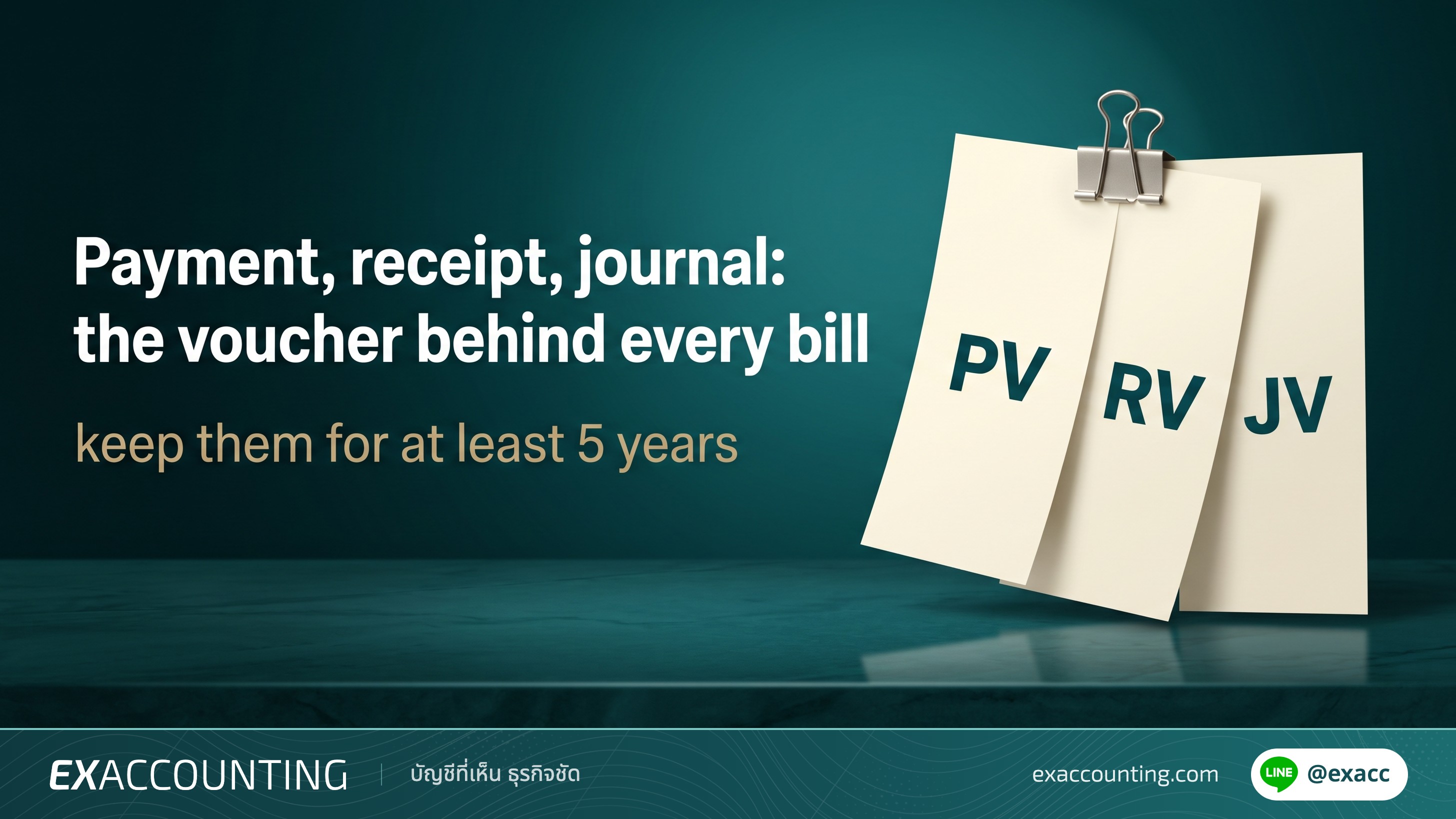
PV, RV and JV are the three kinds of voucher accountants use to support entries in the books. A PV (payment voucher) is for money going out, an RV (receipt voucher) is for money coming in, and a JV (journal voucher) is for entries with no cash movement, such as depreciation. A voucher is an internal document the business prepares itself, showing which accounts are used, on which side, for how much, and who approved it, with the source documents such as tax invoices and receipts attached. Thai law does not prescribe a voucher name or form, but it does require every entry in the books to have supporting documents.
How PV, RV and JV differ
- PV, payment voucher: money out through any channel, such as paying suppliers, rent, salaries and utilities
- RV, receipt voucher: money in through any channel, such as cash sales, customer payments and interest received
- JV, journal voucher: entries with no cash movement, such as depreciation, accrued expenses, adjustments and reversals of wrong entries
Some businesses also use separate vouchers for credit purchases and credit sales. Names and abbreviations are each business's own convention.
Where vouchers fit in Thai accounting law
Department of Business Development (DBD) notifications under the Accounting Act B.E. 2543 (2000) group supporting documents into three types:
- Documents outsiders give the business: purchase tax invoices, supplier receipts, electricity bills, bank statements
- Documents the business gives outsiders: sales tax invoices, receipts, withholding tax certificates (50 Tawi)
- Documents the business makes for its own use: PV, RV and JV vouchers belong here
The business must keep its books and supporting documents for at least 5 years from the closing date and must hand complete documents to its bookkeeper.
What a good voucher contains
- Business name, voucher type and a sequential number
- Transaction date
- Description, and the name of the payee or payer
- Account codes and names, debit and credit amounts, with equal totals
- Payment channel, such as cash, bank account number or cheque number
- Reference numbers of the attached source documents
- Signatures of the preparer, reviewer, approver, and the payee for a PV
Example: a rent PV with withholding tax
A company pays October warehouse rent of THB 15,000 to an individual landlord, withholds 5% tax, and transfers the balance from its savings account (no VAT in this example):
- Dr rent expense: 15,000
- Cr withholding tax payable: 750
- Cr bank, savings account: 14,250
Attached to this PV: the lease or invoice, the landlord's receipt, proof of transfer, and a copy of the 50 Tawi issued to the landlord. The THB 750 must be remitted on PND 3 the following month. This example uses the normal filing route. If the rent is paid through e-Withholding Tax while the reduced-rate measure is in force, the rate drops to 1% and no 50 Tawi is needed. For the rate on each type of income, see Thai withholding tax rates.
How vouchers connect to the journal
One voucher is one entry in the journal. If the business uses special journals, PVs usually go to the cash payments journal, RVs to the cash receipts journal, and JVs to the general journal. The voucher number becomes the reference in the general ledger, so any figure in the statements can be traced back to the original bill. This is the same path auditors and Revenue Department officers follow.
What owners need to do with vouchers
- Send complete source documents: a voucher with no bill attached is the weakest point in an audit. See the monthly documents checklist.
- Sign off payments: if your accounting firm or staff prepare vouchers, the owner or an authorised person should approve them.
- Payments without a bill: keep proof of payment and have the payee sign for it, or the expense may be questioned as not genuinely the business's.
- Do not destroy a wrong voucher: have the accountant issue a JV to reverse it, then a new correct one.
- File by number and month: so you can find them quickly when an auditor or officer asks.
Can you do it yourself?
Yes. There is no required form, so a simple template or a printout from accounting software works. The harder part is choosing the right accounts, separating input VAT and withholding tax correctly, and covering every transaction every month. Many businesses keep the bills and sign approvals themselves, and let an accounting firm prepare the vouchers and record the entries. If you want our bookkeeping team to handle it, see the scope on our pricing page.
FAQ
What is the difference between PV, RV and JV?
PV is for payments, RV for receipts, and JV for entries with no cash movement, such as depreciation and adjustments.
Do we need a voucher for every transaction?
The law requires supporting documents for entries but does not prescribe a voucher form. In practice, a voucher for every transaction makes approval, checking and lookups much easier.
How long must vouchers be kept?
With the books and other supporting documents, for at least 5 years from the closing date.
Can a payment voucher replace a receipt?
No. A payment voucher is made by the business itself; a receipt or tax invoice is evidence from the payee. Attach both. If the payee cannot issue a receipt, have them sign for the money and attach proof of payment.
References
Checked 20 November 2026
Want our accountants to look at this for you?
Add us on LINE and tell us about your business. Our assistant will ask a few basics before passing you to an accountant.