Disallowed input VAT in Thailand: bills you cannot claim
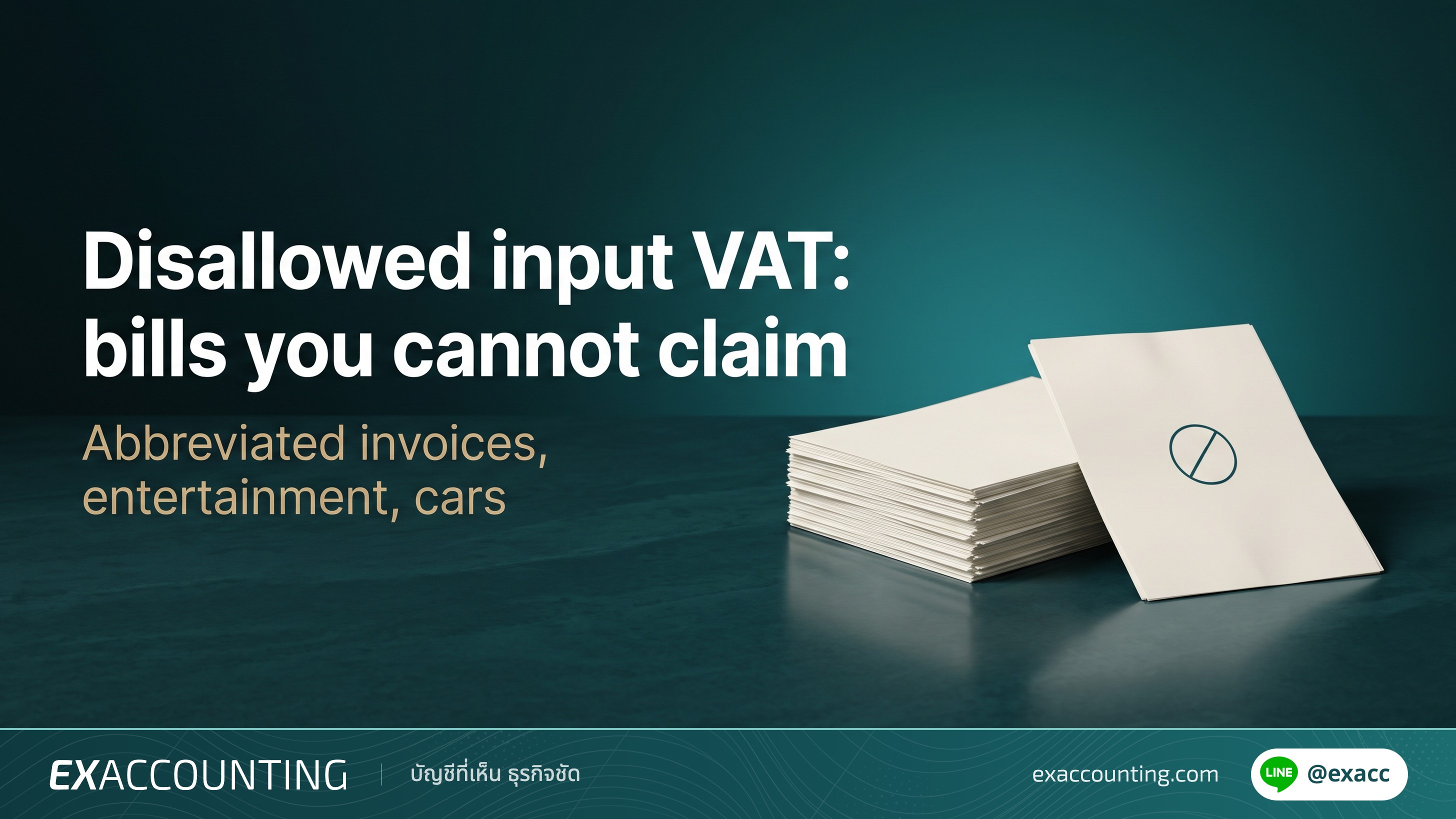
Disallowed input VAT is VAT you paid but cannot deduct on PP 30, such as abbreviated invoices, entertainment and cars. How to check bills and book it.
Disallowed input VAT is VAT your company has paid to a supplier but may not deduct from output VAT on the monthly PP 30 return. There are two groups of reasons. In the first, the document is not acceptable: there is no tax invoice, only an abbreviated one, or the invoice is incomplete. In the second, the type of expense is not creditable even with a correct invoice, such as client entertainment and costs related to passenger cars. The legal basis is Section 82/5 of the Revenue Code and Director-General Notifications on VAT No. 17 and No. 42.
Group one: the bill is not acceptable
Before sending bills to your accounting firm, check the document itself. If any of these apply, the VAT on that bill cannot be claimed.
- No tax invoice at all, only a transfer slip or an ordinary receipt.
- An abbreviated tax invoice, the kind a retailer prints from the cash register without the buyer's name.
- A full tax invoice with missing or wrong details under Section 86/4, for example without your company's name, or made out to the employee who did the buying.
- The seller's name, address or tax ID handwritten rather than printed or computer-generated.
- A copy, unless issued as part of a set with other commercial documents and marked as such.
- Altered entries, other than in the way the Director-General allows.
- Issued by someone not entitled to issue it, such as a shop that is not VAT-registered.
Most of this group can be fixed if caught early: ask the seller for a new full tax invoice in the company's name. What a tax invoice must contain is in our tax invoice guide.
Group two: the bill is fine, but the expense is not creditable
- Entertainment, such as food, drinks, accommodation, shows, sports and gifts to the guests.
- Passenger cars and passenger vehicles with up to 10 seats: buying, hire-purchase, rental, and goods or services related to them such as fuel and repairs. Exceptions are businesses that sell or rent out such cars directly, and motor insurers.
- Other vehicles converted into passenger cars or vehicles with up to 10 seats within 3 years of acquisition.
- Expenses not directly related to the business, such as the owner's personal items bought in the company's name.
- Expenses of a VAT-exempt activity, and the share of input VAT allocated to it when a company has both taxable and exempt activities.
"Passenger car" here follows the definition in the excise tariff law, not everyday naming. If you are unsure whether a company vehicle falls within it, send a copy of the registration book to your accounting firm.
Bills small companies often get
- Dinner with a client, full tax invoice in the company's name: not claimable, because it is entertainment.
- Fuel for the company sedan: not claimable, because it relates to a passenger car.
- Office supplies from a department store with a cash-register receipt: an abbreviated invoice, so not claimable. Ask for a full tax invoice at the service counter on the day.
- Raw materials from a VAT-registered supplier with a correct full tax invoice: claimable as normal.
How is the disallowed VAT booked?
The VAT is not recoverable from the Revenue Department, so it becomes part of the cost or expense itself. For example, a client dinner of 2,140 baht (2,000 baht food and 140 baht VAT) is booked as 2,140 baht of entertainment, and the 140 baht does not go into the input tax report.
The next question is whether that expense is deductible for corporate income tax. Under Section 65 ter (6 bis), input VAT is generally non-deductible, but there is an exception for input VAT that cannot be credited under Section 82/5(4) and (6), for example:
- input VAT on entertainment
- input VAT related to passenger cars and vehicles with up to 10 seats
- input VAT on abbreviated tax invoices
- input VAT of a VAT-exempt activity, or the share allocated to it
Input VAT disallowed because there is no invoice or the invoice is defective is not covered by this exception, so it must be added back when computing taxable profit. A bad bill costs you twice, in VAT and in income tax. Other add-backs are covered in non-deductible expenses.
A late invoice is not disallowed
A tax invoice received late is not disallowed input VAT. Under Director-General Notification No. 4, it can be claimed in a later month, within 6 months from the month after the invoice was issued, with a note on the invoice stating which tax month it is claimed in. (A bill older than 6 months is not lost. Section 82/3 allows a claim within 3 years of the invoice date, but under Revenue Department practice it must go on an additional return for the month the invoice was issued, not the current month. Let your accounting firm handle this case.) So if bills are still missing near the deadline, file with what you have and use the late ones next month.
How to send bills without losing the credit
- Ask for a full tax invoice every time you buy for the company. Give the seller the company name, address and tax ID when you pay.
- Send originals, not copies. For electronic invoices, send the file the seller issued, not a photo of a printout.
- Flag bills for entertainment or cars, so the firm separates them from the start instead of correcting the input tax report later.
- Send them before month-end close, so problems can be checked and new invoices requested before filing.
EXACCOUNTING clients send their bills through PERPOS Books, which lets the firm spot problem bills early in the month.
Can you do it yourself?
You can do the first sort yourself if you remember two rules: the bill must be a full tax invoice in the company's name, and entertainment and sedan costs cannot be claimed. The harder parts are borderline cases, such as whether a vehicle counts as a passenger car, how a company with both taxable and exempt income allocates input VAT, and carrying the effect through to income tax at year-end. If you want the input tax report and financial statements to agree every month, our tax team can handle it. See the scope on our pricing page.
FAQ
What is disallowed input VAT, in short?
No invoice, a defective or incomplete invoice, an abbreviated invoice, a copied or altered invoice, an invoice from someone not entitled to issue one, entertainment, costs related to passenger cars with up to 10 seats, expenses unrelated to the business, and input VAT of VAT-exempt activities.
Can we claim VAT on fuel for the company pickup truck?
It depends on whether that vehicle is a passenger car under the excise law definition, not on what it is called. Have your accounting firm check the registration book first.
Why keep entertainment bills if the VAT cannot be claimed?
They still support the income tax deduction, for both the entertainment cost and the disallowed VAT, subject to the legal conditions for entertainment expenses.
We already claimed disallowed VAT on PP 30. What now?
Correct it with an additional return for that month, which brings a surcharge and penalty. See how they are calculated in late or incorrect PP 30 filing.
References
Checked 20 November 2026
- Revenue Code Sections 80–82 (disallowed input tax, Section 82/5) (Thai)
- Revenue Code Sections 85–86 (tax invoices, Section 86/4) (Thai)
- Director-General Notification on VAT No. 17 (Thai)
- Director-General Notification on VAT No. 42 (Thai)
- Director-General Notification on VAT No. 4, input tax claimed in a later month (Thai)
- Revenue Department: Section 65 ter, non-deductible expenses (Thai)
Want our accountants to look at this for you?
Add us on LINE and tell us about your business. Our assistant will ask a few basics before passing you to an accountant.