Thai credit notes and debit notes: when to use them and how they affect VAT
Credit and debit notes adjust a tax invoice already issued. See the reasons allowed under sections 82/9 and 82/10, the month to issue, contents and VAT effect.
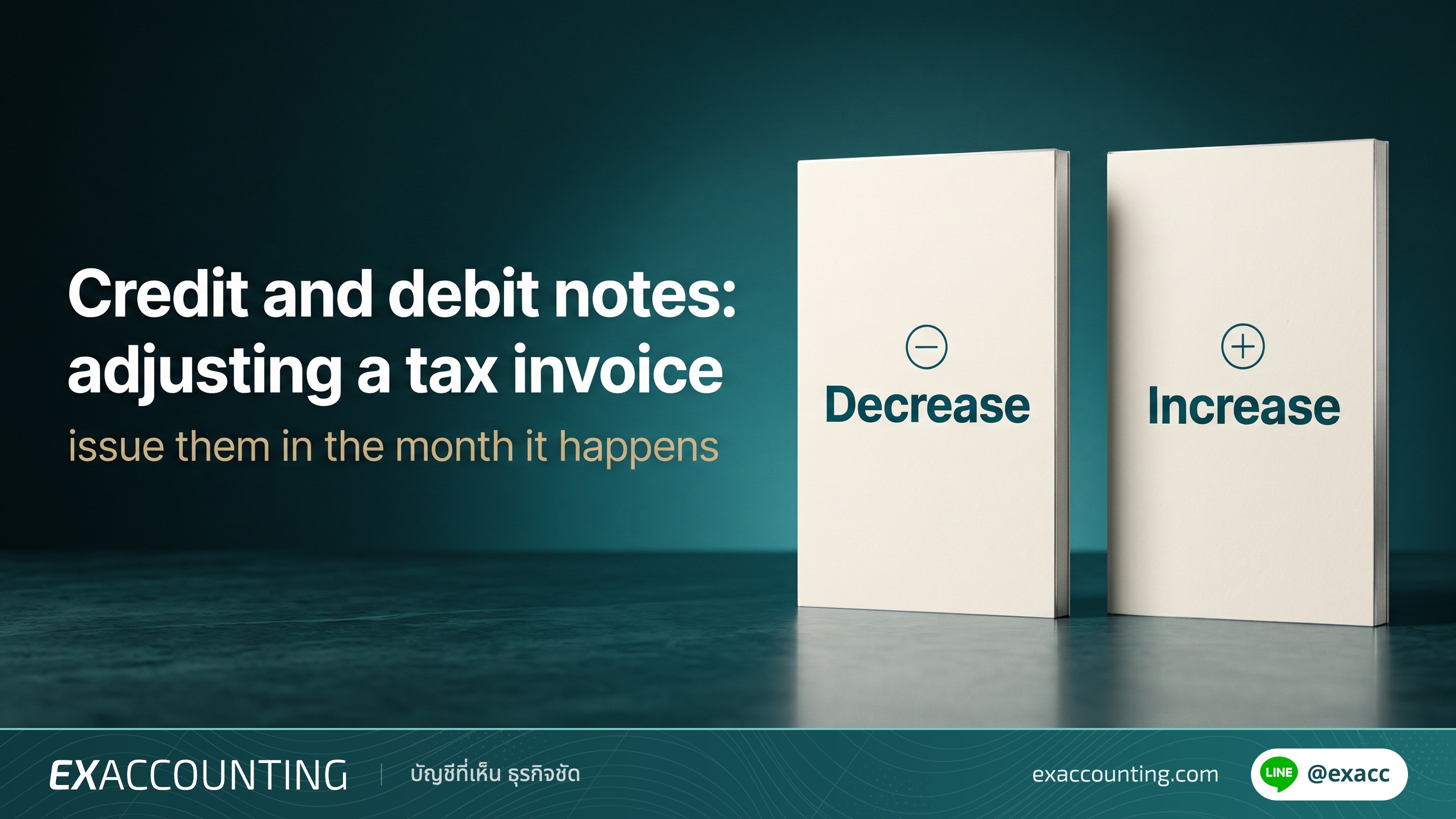
Credit notes and debit notes are issued by a VAT-registered seller to adjust the value of a sale for which a tax invoice was already issued. A credit note is for a decrease, such as defective goods returned or an overcharge. A debit note is for an increase, such as extra goods delivered or an undercharge. They must be issued in the tax month the event occurs, only for the reasons the Revenue Code allows, and they affect the seller's output VAT and the buyer's input VAT in that month.
Which one? Look at the direction of the amount
| Situation | Document |
|---|---|
| Customer returns goods that are defective or not as sampled | Credit note |
| Price cut for short delivery, wrong specification or deficient service | Credit note |
| Price or fee charged higher than agreed | Credit note |
| More goods delivered or more service given than agreed | Debit note |
| Price or fee charged lower than agreed | Debit note |
| Customer's name, address or tax ID misprinted | Neither: cancel and issue a new tax invoice |
Reasons the law allows for a credit note
Section 82/10 sets four groups:
- Price reduction on goods because they do not meet the agreed specification, are defective, short in quantity, or the price was miscalculated too high.
- Reduction in service fees because the service did not meet the agreed specification, was deficient, or the fee was miscalculated too high.
- Goods returned because they are defective, not as sampled or not as described.
- Termination of a service contract under the reasons and conditions set by the Director-General.
Each group also allows "other reasons set by the Director-General". If your reason fits none of them, such as a goodwill discount given afterwards, consult your accountant or the local Revenue office before issuing.
Debit notes follow section 82/9: goods delivered over the agreed quantity, service beyond the agreed specification, or a price miscalculated too low.
Which month?
Issue it in the tax month the event occurs. If the customer returns goods in March, the credit note is issued in March. If there is a genuine reason it cannot be issued in time, issue it in the following tax month. Do not go back and change the original month's tax invoice. That invoice and the month's PP 30 return stay as they were; the adjustment happens in the month the note is issued.
What it must show
- The words "Credit Note" or "Debit Note", prominently.
- The issuer's name, address and tax ID.
- The buyer's or service recipient's name and address.
- The date issued.
- The number (and book, if any) of the original tax invoice, the original value, the correct value, the difference and the VAT on the difference.
- A short explanation of the reason.
- Other items the Director-General specifies.
Items 5 and 6 are what the accountant uses to match the note to the original invoice. A credit note without the original number or a reason will be questioned in an audit.
Effect on output and input VAT
| Seller (issuer) | VAT-registered buyer (recipient) | |
|---|---|---|
| Credit note | Deduct the VAT on the note from output VAT, in the month issued | Deduct the VAT on the note from input VAT, in the month received |
| Debit note | Add it to output VAT, in the month issued | Add it to input VAT, in the month received |
Buyers often forget. If you receive a credit note and do not pass it to your accountant, that month's input VAT is overstated. For the arithmetic, see how to calculate VAT.
When not to use a credit note
- A misprinted tax invoice, such as the wrong name, address or tax ID: cancel it and issue a new one. See what a Thai tax invoice must include.
- A discount agreed at the time of sale: deduct it on that tax invoice.
- Not VAT-registered: you cannot issue a credit note under the Revenue Code. For a refund or reduction, use an ordinary commercial document and do not show VAT.
Copies of credit and debit notes must be kept for at least 5 years, like tax invoices.
Can you do it yourself?
The document itself is easy to issue. The care goes into deciding whether the reason falls under section 82/10, and recording it in the right month on both the issuing and receiving side. The safe practice is to ask your accountant before issuing any credit note that is not plainly a return or a billing error, and to send a copy within the same month. If you want our tax team to keep the output and input VAT reports and PP 30 matched to your documents every month, see the scope on our pricing page.
FAQ
Within how many days must a credit note be issued?
The law does not count days. Issue it in the tax month the event occurs, or the following month if there is a genuine reason.
Can a business without VAT registration issue a credit note?
A credit note under the Revenue Code can only be issued by a VAT-registered business. Others use an ordinary commercial document and must not show VAT.
I received a credit note from a supplier. What do I do?
If you are VAT-registered, deduct the VAT on the note from input VAT in the month you received it, and adjust the recorded cost or expense. Send the copy to your accountant with that month's documents.
Can I issue a credit note to correct a misspelt customer name?
No. Cancel the original tax invoice and issue a new one. Credit notes only adjust value.
References
Checked 20 November 2026
- Revenue Department: Revenue Code sections 81 to 82/18, output tax, input tax, debit and credit notes (Thai)
- Revenue Department: Revenue Code sections 85 to 86/14, tax invoices, debit and credit notes (Thai)
- Revenue Department: Revenue Code sections 87 to 90/5, record keeping, surcharges and penalties (Thai)
Want our accountants to look at this for you?
Add us on LINE and tell us about your business. Our assistant will ask a few basics before passing you to an accountant.