How to calculate Thai VAT at 7%: adding and extracting VAT
Add Thai VAT with 7/100 of the pre-VAT price; extract it from a VAT-inclusive price with 7/107. Worked examples, discounts, invoices and PP 30.
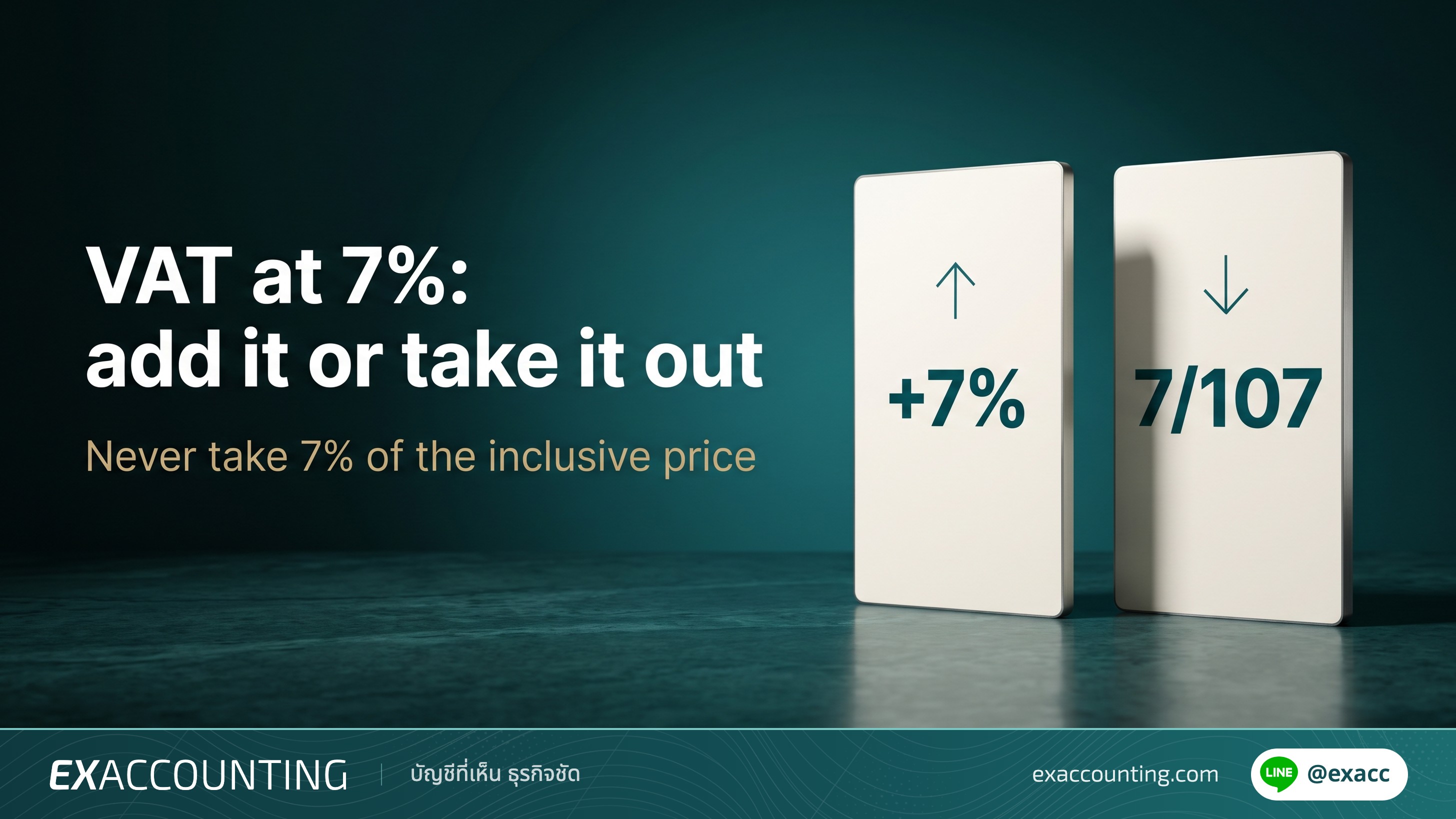
There are two ways to calculate VAT. If your price excludes VAT, multiply by 7 and divide by 100 to get the VAT to add. If your price already includes VAT, multiply by 7 and divide by 107 to extract it. Do not simply take 7% of the inclusive price; that overstates the VAT. The current rate is 7% until 30 September 2027, and whichever way you price, the tax invoice must show the value of goods and the VAT amount separately.
Where does 7% come from?
The rate in the Revenue Code is 10%, but royal decrees have kept reducing it. Today it is 6.3% VAT plus a local tax of one ninth of that rate, which adds up to 7%. Businesses calculate and show a single 7% rate without splitting it. The rate has been extended to 30 September 2027. If the rate changes, the formulas below change with it.
Price excludes VAT: add it
- VAT = pre-VAT price × 7 ÷ 100
- Price including VAT = pre-VAT price × 107 ÷ 100
Example: a design fee of 25,000 baht before VAT. VAT = 25,000 × 7 ÷ 100 = 1,750 baht. The customer pays 26,750 baht in total.
Price includes VAT: extract it
- VAT = VAT-inclusive price × 7 ÷ 107
- Pre-VAT price = VAT-inclusive price × 100 ÷ 107
Round example: a sticker price of 5,350 baht including VAT. Pre-VAT price = 5,350 × 100 ÷ 107 = 5,000 baht, and VAT = 350 baht.
Example with decimals: a sticker price of 1,999 baht including VAT. VAT = 1,999 × 7 ÷ 107 = 130.78 baht (rounded to 2 decimals). Pre-VAT price = 1,999 − 130.78 = 1,868.22 baht.
A simple safeguard: find the VAT first, then subtract it from the inclusive price to get the pre-VAT price. The two figures will always add back to the sticker price.
Why 7% of the inclusive price is wrong
The 7% is charged on the pre-VAT price, and the inclusive price is 107% of that. Taking 7% of the inclusive price charges VAT on VAT. In the 5,350 baht example, 7% gives 374.50 baht, while the real VAT is 350 baht. Correctly extracted VAT is about 6.54% of the inclusive price.
Discounts come before VAT
A discount given at the time of sale and shown clearly is deducted from the value before VAT is calculated.
Example: goods of 20,000 baht with a 5% discount come to 19,000 baht. VAT = 19,000 × 7 ÷ 100 = 1,330 baht, for a total of 20,330 baht.
If you reduce the price or take goods back after the tax invoice is issued, do not edit the original. Issue a credit note, which adjusts VAT in the month the credit note is issued.
What the tax invoice must show
Section 82/4 lets VAT-registered businesses display VAT-inclusive prices, for example on shelf labels. But a full tax invoice must show the value of goods or services and the VAT amount separately under Section 86/4. Other required details are in our tax invoice guide.
Quotations should say clearly whether the price "includes VAT" or "excludes VAT". Ambiguity here is the most common cause of payment disputes between buyers and sellers.
The amount due on PP 30
At month-end, your accounting firm totals the output VAT on the tax invoices you issued and deducts the creditable input VAT. The difference is the figure on PP 30.
Hypothetical example:
- Taxable sales 350,000 baht, output VAT 24,500 baht
- Creditable purchases 210,000 baht, input VAT 14,700 baht
- VAT payable = 24,500 − 14,700 = 9,800 baht
In a month where input VAT exceeds output VAT, the excess can be refunded in cash or carried forward to the next month, depending on what you choose on the form.
Some input VAT cannot be deducted even with an invoice, such as entertainment and fuel for a sedan. Take it out before totalling; see disallowed input VAT.
Mistakes accounting firms see often
- Taking 7% of the inclusive price, so the VAT in the books is higher than on the invoice.
- Quotations that do not say whether VAT is included, so customers pay too little or too much.
- Rounding differently on invoices and in the books, so the output tax report drifts away from the ledger.
- Including disallowed input VAT in the deduction, so too little VAT is paid and an additional return with a surcharge follows.
Can you do it yourself?
Yes. The formulas are just 7/100 and 7/107, and any calculator or spreadsheet will do. What goes wrong when owners do it themselves is totalling the month, removing disallowed input VAT, handling credit notes and keeping the tax reports in line with the books every month. If you want this closed every month without chasing figures yourself, our tax team can handle it. See the scope on our pricing page.
FAQ
A price is 1,000 baht including VAT. How much is the VAT?
1,000 × 7 ÷ 107 = 65.42 baht. The pre-VAT price is 934.58 baht.
Can a shop that is not VAT-registered add 7% VAT to its bills?
No. A business that is not VAT-registered may not charge VAT or issue tax invoices. If your sales are near the threshold, talk to your accounting firm about VAT registration.
Why is extracted VAT not 7% of the inclusive price?
Because the inclusive price is 107% of the pre-VAT price, so VAT is 7/107 of the inclusive price, about 6.54%.
References
Checked 20 November 2026
- Revenue Code Sections 80–82 (rate, VAT-inclusive pricing under Section 82/4) (Thai)
- Revenue Code Sections 85–86 (tax invoices, Section 86/4) (Thai)
- Revenue Code Sections 77–79 (tax base and discounts, Section 79) (Thai)
- Revenue Department: 6.3% plus one-ninth local tax equals 7% (Thai)
- Revenue Department press release 18/2569: 7% VAT extended to 30 September 2027 (Thai)
- Revenue Department: PP 30 form with instructions (Thai)
Want our accountants to look at this for you?
Add us on LINE and tell us about your business. Our assistant will ask a few basics before passing you to an accountant.