Thai freelance income tax: 40(2) vs 40(8) income and the records to keep all year
Thai freelancers file PND 90, and 40(2) vs 40(8) income changes the expense deduction a lot. See how to tell, an example, the 0.5% method, PND 94 and 50 Tawi.
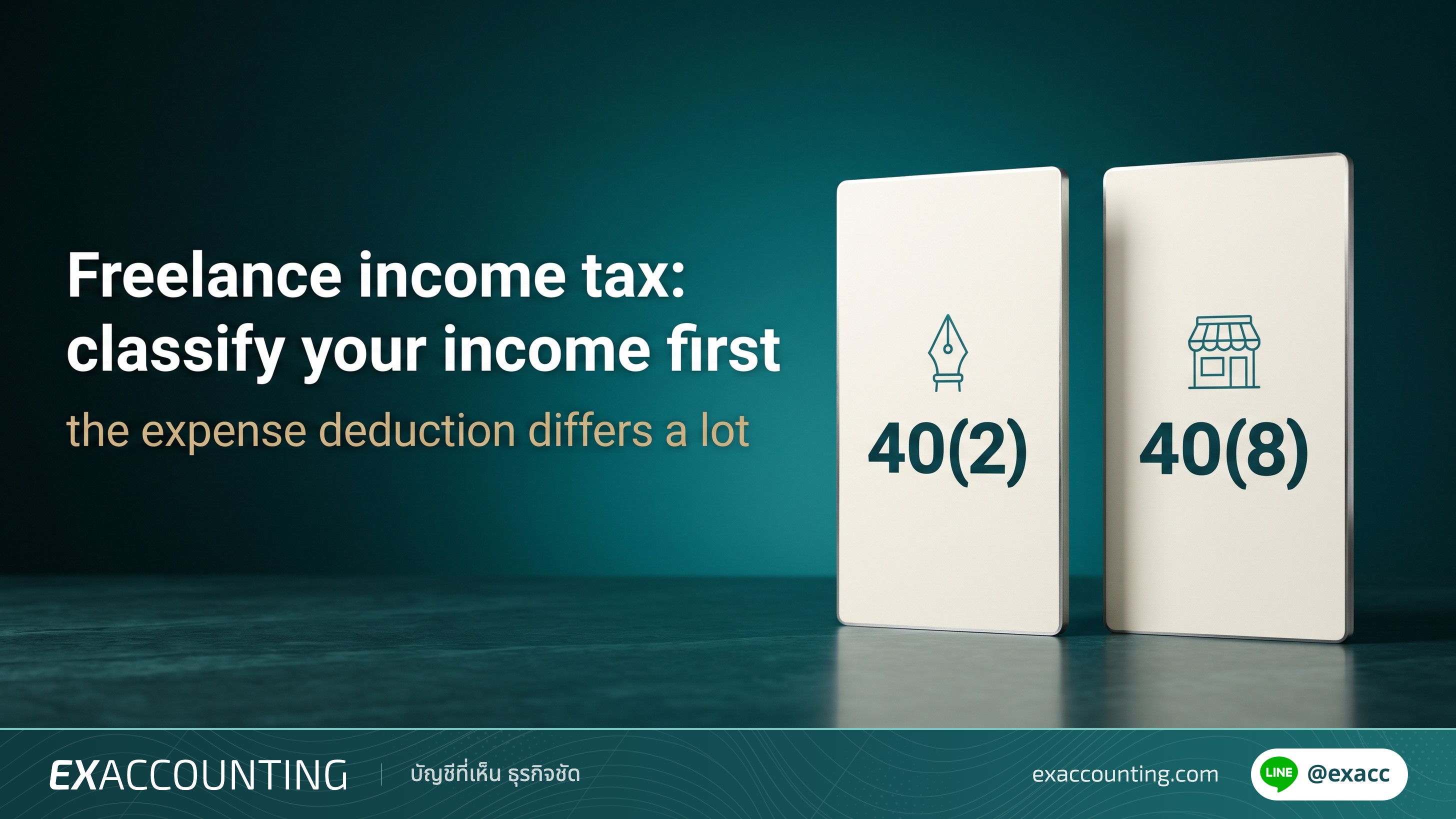
Freelancers in Thailand file their annual tax on PND 90, because they have income other than salary. The question that matters most for the tax bill is whether your income is type 40(2) or 40(8). 40(2) allows a flat 50% expense deduction, capped at 100,000 baht combined with any salary. 40(8) in one of the 43 business types listed by the Revenue Department allows a flat 60%, without that cap. The type depends on the real nature of the work, not the name in the contract, and anyone with 40(8) income above the first-half threshold must also file PND 94 mid-year.
How do 40(2) and 40(8) differ?
| 40(2) | 40(8) | |
|---|---|---|
| Nature | Income from a duty or position, or from doing work for someone, such as fees, commissions, meeting fees | Income from business, commerce, agriculture, industry, transport, or other income not in 40(1) to 40(7) |
| Expense deduction | Flat 50%, capped at 100,000 baht combined with salary | Flat 60% if in the 43 types, or actual expenses |
| Mid-year PND 94 | Not required | Required if January to June income is above the threshold |
If you are not sure which type your work falls into, ask your local Revenue office or the Revenue Department call centre on 1161 before filing. Do not pick a type because it gives less tax.
The 43 business types with a 60% flat deduction
Examples freelancers and small shops often meet:
- Selling goods the seller did not make
- Literary work
- Performances by actors, singers and musicians: flat 60% on the first 300,000 baht, 40% on the excess, capped at 600,000 baht in total
- Hairdressing, haircutting or beauty treatment
- Hotels, restaurants, or preparing food and drinks for sale
- Tailoring, sewing, knitting and embroidery
- Transport or hire using vehicles
40(8) work not in the 43 types can only deduct actual expenses that are necessary and documented. In the online system, choose "other income" (Thai: เงินได้อื่นๆ) and enter the actual expenses.
Example: 480,000 baht income for the year
Assume no salary and only the personal allowance.
| If 40(2) | If 40(8), flat 60% | |
|---|---|---|
| Income | 480,000 | 480,000 |
| Expenses | −100,000 | −288,000 |
| Personal allowance | −60,000 | −60,000 |
| Net income | 320,000 | 132,000 |
| Tax at progressive rates | 9,500 | 0 |
In both cases the 0.5% method gives 2,400 baht, below 5,000, so it does not apply. The gap comes from the different expense deductions, which is why the type has to be right from the start. In the 40(8) case, if every client was a company that withheld 3% on each job, the 14,400 baht withheld can be claimed back in full.
The 0.5% method for higher earners
If your 40(2) to 40(8) income totals 120,000 baht or more, you work out tax two ways and pay the higher. The first is the normal progressive rates. The second is 0.5% of assessable income excluding salary. If the second comes to 5,000 baht or less, it does not apply. In practice it bites when income is above 1,000,000 baht but net income is low, for example after a large flat deduction.
Withholding tax and the 50 Tawi
- A company or partnership paying an individual for services that are 40(8) income must withhold 3% when the contract amount is 1,000 baht or more.
- Ask for a 50 Tawi certificate every time tax is withheld, and check the name, ID number and amounts on the day you receive it. See the 50 Tawi withholding certificate.
- When you file PND 90, the year's withheld tax is a credit. If it is more than the tax due, you can claim a refund.
Mid-year filing on PND 94
40(5) to 40(8) income received from January to June above the threshold (over 60,000 baht if single, over 120,000 baht combined if married) must be reported on PND 94 between July and September, and the tax paid is credited on PND 90 at year end. Freelancers with only 40(2) income do not file PND 94. If you are unsure which forms apply to you, see PND 90 vs PND 91.
Records that make filing easy
- Income log: for every job, the date, payer, gross amount, tax withheld and 50 Tawi number
- 50 Tawi folder: filed by month, with totals matching the income log
- Expense receipts: needed if you deduct actual costs, or if your work is not in the 43 types
- Half-yearly review: before PND 94 and before year end, check whether income has grown enough to consider a company. See sole trader vs company tax.
Can you do it yourself?
Yes, if your work clearly fits one type and you have a few clients. The Revenue Department's online system does the calculation. The real work is keeping a complete record of income and 50 Tawi certificates all year, and deciding between flat and actual expenses. An accountant is worth involving when you mix several types of work, income starts to pass 1,000,000 baht, or you are thinking of setting up a company. See our advisory service and the scope on our pricing page.
FAQ
My freelance income is small. Do I still file?
A single person with income other than salary above 60,000 baht a year must file PND 90, even if no tax is due. If tax was withheld, filing is the only way to get it back.
What is 40(8) income?
Income from business, commerce, agriculture, industry, transport and any other income not in types 40(1) to 40(7). It takes a flat 60% expense deduction if it is one of the 43 listed types, otherwise actual expenses.
I have a salary and freelance work. How are expenses deducted?
File PND 90. If the freelance work is 40(2), the flat 50% is capped at 100,000 baht combined with your salary. If it is 40(8), expenses are deducted separately from salary according to the type of work.
References
Checked 20 November 2026
- Revenue Department: how to complete PND 90 for tax year 2025 (Thai)
- Revenue Department: explanation of withholding under Order Tor. Por. 101/2544 (Thai)
- Revenue Department: Clear Cut guide to filing PND 90/91 online (Thai)
- Revenue Department: personal income tax filing deadlines (Thai)
- Revenue Department: how to complete PND 94 for tax year 2026, who must file (Thai)
Want our accountants to look at this for you?
Add us on LINE and tell us about your business. Our assistant will ask a few basics before passing you to an accountant.